App Growth
Mobile Marketing
Google Play Store vs App Store ASO: The Strategies That Actually Differ

Codse Tech
March 9, 2026
Teams that treat App Store Optimization as a single playbook across both marketplaces usually leave rankings and installs on the table.
Google Play Store optimization and Apple App Store optimization overlap in fundamentals, but the ranking signals are not identical. Metadata fields carry different weight, indexing behavior is different, and release workflows create different testing windows. A strategy that performs well in one store can underperform in the other.
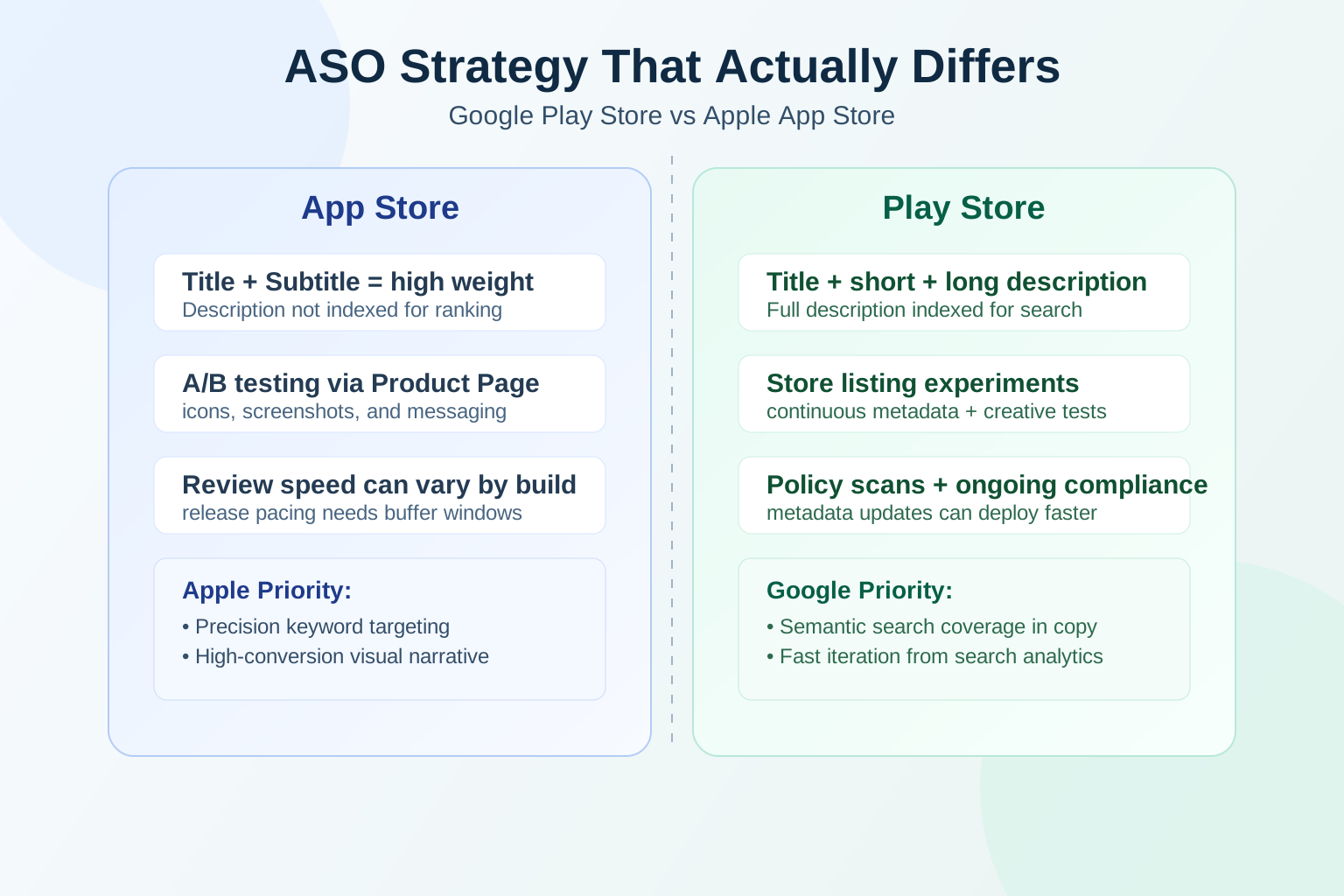
This guide breaks down the practical differences that matter in 2026, including title strategy, description structure, review process implications, visual creative strategy, and keyword execution by store.
Quick answer: what is the biggest ASO difference?
The single highest-impact difference is indexing behavior:
- On Google Play, long-form metadata fields contribute to discoverability, so full-description structure matters for Play Store optimization.
- On Apple App Store, high-priority keyword fields are more constrained, so precision and field efficiency matter more than long-form copy.
That difference changes how keyword maps are built, how copy is written, and how iteration cycles are prioritized.
Side-by-side comparison table (2026)
| Area | Apple App Store ASO | Google Play Store ASO | Strategic implication |
|---|---|---|---|
| Core metadata weight | Title, subtitle, keyword field carry outsized importance | Title, short description, and long description contribute to relevance | Apple rewards precision density; Google rewards semantic coverage |
| Description indexing | Limited ranking impact relative to core keyword fields | Stronger discoverability impact from structured long description | Write benefit-rich semantic copy for Play; compress keyword intent on Apple |
| Keyword strategy | Tight prioritization of high-intent terms in constrained fields | Broader topical clusters and natural language variants | Separate keyword maps by store, not one shared list |
| Creative testing | Product Page Optimization with variant sets | Store Listing Experiments + localized listing tests | Run different test cadence per store review and deployment realities |
| Review workflow | Build review cycles can be less predictable | Policy and listing checks are continuous and often faster for metadata updates | Plan Apple creative experiments with longer buffers |
| Localization leverage | Strong gains from market-specific metadata fields and screenshots | Strong gains from localized copy depth and regional phrasing | Localize intent, not just translation |
| Ratings and reviews | Ratings quality and cadence influence conversion confidence | Ratings, review velocity, and sentiment patterns heavily influence store performance | Build review generation and response SOPs for both stores |
| Category competition | Competitive keyword slots in narrower field constraints | Broader ranking opportunities through long-tail semantic intent | Apple prioritizes rank-defense; Google prioritizes rank-expansion |
| Conversion emphasis | Screenshot storytelling and trust cues are critical | First-screen value + copy-message alignment are critical | Creative strategy should match store browsing behavior |
Where most ASO strategies fail
Many app teams run the same workflow in both stores:
- One keyword list.
- One title concept.
- One screenshot narrative.
- One release cadence.
That approach ignores platform-specific ranking mechanics. The result is usually predictable:
- Under-indexed Play listings because long-description opportunities were not used.
- Overstuffed Apple metadata fields that reduce clarity and conversion.
- Creative tests that run without statistically clean windows.
- Ranking fluctuations after updates due to poor release timing.
ASO works best when App Store and Play Store are treated as two channels with shared brand goals but different search engines.
Title strategy: same character budget mindset, different execution
Apple App Store title strategy
On Apple, title and subtitle decisions should prioritize:
- High-intent phrases with commercial relevance.
- Clear category fit.
- Distinctiveness against close competitors.
Overloading the title with broad phrases can reduce clarity and hurt conversion, even when discoverability improves short term. The strongest Apple listings balance exact-match relevance with a readable positioning statement.
Google Play title strategy
On Play, title still matters heavily, but performance improves when title logic is aligned with short- and long-description themes. Play rankings respond better when metadata fields reinforce one coherent intent cluster rather than isolated keywords.
A practical Play pattern:
- Title = primary term + core value proposition.
- Short description = problem/benefit expression in natural language.
- Long description = semantic expansion through use cases, outcomes, and feature relevance.
Description strategy: why Play Store optimization needs content architecture
Play Store optimization benefits from structured long descriptions. High-performing listings often follow a clear architecture:
- Value proposition above the fold.
- Feature blocks grouped by use case.
- Proof signals (trust, stability, support).
- Conversion close with clear audience fit.
This is not keyword stuffing. The goal is semantic depth with readable copy. Search systems in 2026 reward intent coverage and user relevance, not repetitive phrase frequency.
For Apple App Store optimization, long-form description still supports conversion and quality signals, but ranking impact is less direct than on Play. Apple metadata work should focus first on high-leverage fields.
Keyword approach: constrained precision vs semantic breadth
Apple keyword approach
Apple optimization should be treated like constrained portfolio management:
- Prioritize terms by intent and achievable difficulty.
- Remove low-value duplicates across indexed fields.
- Maintain strict mapping between keyword targets and screenshot message hierarchy.
Each slot has opportunity cost. If a low-intent keyword occupies a high-impact field, a stronger acquisition term is displaced.
Google Play keyword approach
Play keyword strategy should be organized into semantic clusters:
- Core category intent terms.
- Problem-oriented search phrasing.
- Benefit and outcome phrasing.
- Feature-specific long-tail variants.
Clusters should be reflected naturally across metadata fields and iterative release notes where relevant. Play rankings improve when listing language mirrors how users describe goals, not just feature labels.
Creative strategy: screenshots and experiments should not be mirrored 1:1
Creative parity across stores looks efficient but underperforms. The browsing context and metadata interaction differ enough that visual messaging should be tuned separately.
App Store creative focus
For Apple listings, screenshot sets should prioritize:
- Immediate category clarity in first visual frame.
- Trust and polish cues.
- Concise narrative progression across screenshot sequence.
When Product Page Optimization tests are run, keep one variable isolated per test cycle (headline tone, first screenshot layout, proof element, or CTA framing).
Play Store creative focus
Play creative should prioritize:
- Message alignment with short-description intent.
- Clarity of use-case outcomes.
- Experiment velocity with clean test hypotheses.
Play Store Listing Experiments can support faster iteration loops for creative and metadata combinations. Teams that pair visual tests with metadata updates often unlock stronger cumulative gains than isolated creative-only cycles.
Review process and release rhythm: ASO impact is operational, not just editorial
ASO performance depends on operational timing. Review processes affect how quickly experiments produce reliable outcomes.
Apple release rhythm
Apple updates may have more variable review windows depending on build context and release history. Practical implications:
- Avoid stacking too many ASO variables in one submission cycle.
- Schedule experiments with longer measurement windows.
- Maintain a holdout baseline listing for comparison.
Play release rhythm
Google Play often supports faster listing iteration cycles, but policy compliance and metadata consistency remain critical. Practical implications:
- Run shorter hypothesis loops where data volume supports significance.
- Monitor ranking response after each metadata adjustment.
- Separate policy-risk changes from pure conversion experiments.
A practical 6-week framework for app store vs play store ASO
Week 1: baseline and segmentation
- Capture current ranking positions by target term for both stores.
- Segment terms into acquisition, category, and conversion-intent groups.
- Audit creative assets against top competitors by category.
Week 2: Apple metadata precision pass
- Rebuild title/subtitle/keyword logic around intent priority.
- Remove duplicated or weak-value terms.
- Align first three screenshots with top-intent query theme.
Week 3: Play semantic metadata pass
- Rewrite short + long description for semantic coverage.
- Expand use-case sections using customer language patterns.
- Align first-screen visual message with short-description positioning.
Week 4: creative experiments by store
- Launch Product Page Optimization tests for Apple with one variable per test.
- Launch Store Listing Experiments on Play for first-screen creative or message framing.
- Lock other listing variables during measurement windows.
Week 5: conversion and review loop
- Audit rating/review recency and sentiment themes.
- Build review-response templates for top friction themes.
- Improve listing copy where sentiment indicates expectation gaps.
Week 6: scale winners and localize
- Roll out winning assets and metadata variants.
- Localize listing copy and screenshots for priority markets.
- Rebuild keyword clusters for the next iteration cycle.
Metrics that actually show ASO progress
Vanity install spikes are not enough. For app store optimization and play store optimization, track these in parallel:
- Non-branded keyword rankings by store.
- Impression-to-product-page conversion.
- Product-page-to-install conversion.
- Retention quality by acquisition keyword cluster.
- Review sentiment trend and review response SLA.
- Localization performance gap by market.
The strongest ASO programs link store discovery metrics to downstream product quality metrics. If rankings rise but D7 retention drops, listing promises and product delivery are misaligned.
Common mistakes in app store vs play store ASO
1) Copying Apple metadata logic into Play
This usually causes weak semantic coverage in Play descriptions and slower ranking growth for broader intent terms.
2) Copying Play long-copy style into Apple fields
This usually creates noisy messaging and lower conversion clarity on Apple listings.
3) Testing too many variables at once
When title, screenshots, and short description all change together, causal learning collapses. Test design should isolate variables.
4) Ignoring review operations
Ratings and review trends affect conversion trust in both stores. Review strategy should be operationalized, not reactive.
5) Treating localization as direct translation
Localization should adapt intent patterns and cultural framing. Direct literal translation underperforms in competitive categories.
Decision matrix: where to spend the next ASO hour
When capacity is limited, prioritize based on bottleneck diagnosis.
- If impressions are low in Google Play: focus on semantic metadata depth.
- If impressions are low in Apple App Store: focus on keyword field precision and title architecture.
- If impressions are healthy but installs are low in both: focus on first-screen creative clarity and social-proof cues.
- If installs are healthy but retention is weak: align listing claims with actual onboarding experience.
App category nuance matters
Different categories respond differently to ASO levers.
- Utility apps often gain from clear task-outcome language and trust signals.
- Consumer lifestyle apps often gain from emotion-led creative and social proof.
- B2B and workflow apps often gain from use-case specificity and credibility cues.
- AI-enabled apps often gain from expectation management (capabilities and limits) to reduce uninstall churn.
This is why generic ASO templates usually underperform by month two. Listing strategy should reflect actual category behavior and user intent maturity.
Internal linking and next-step strategy
Teams that want predictable growth from store search should combine ASO execution with product and analytics iteration. For implementation support, see App Store Optimization services.
For broader launch strategy, pair ASO work with:
Final takeaway
Google Play Store optimization and Apple App Store optimization are related disciplines, but not identical systems. The highest-performing teams operate with one growth objective and two platform-specific execution models.
The practical rule for 2026:
- Build precision-first metadata strategy for Apple.
- Build semantic-depth metadata strategy for Google Play.
- Test creatives per store behavior, not by convenience.
- Measure ranking and conversion together, then iterate in short cycles.
That is the difference between occasional ranking wins and repeatable ASO growth.
App Store Optimization
Platform-specific ASO strategies that improve rankings, conversion, and sustainable organic growth.
Explore serviceCustom Software Development
Full-stack mobile and web development to support your growth from launch through scale.
Explore serviceWhat is the biggest difference between Google Play ASO and Apple App Store ASO?+
Google Play indexes the full description for ranking, rewarding semantic depth and keyword variety. Apple relies on a structured keyword field and title, rewarding precision and exact-match relevance. Effective ASO requires platform-specific metadata strategies.
Should I use the same screenshots on both stores?+
No. Google Play users tend to scroll and compare, favoring information-dense screenshots. Apple users often convert from the first two frames, favoring clarity and emotional impact. Test creatives independently per store.
How often should I update my ASO strategy?+
Run short test cycles — typically two to four weeks per variable. Monitor ranking and conversion together after each change, and adjust based on data rather than calendar schedules.
Does localization matter for ASO?+
Yes, significantly. But localization means adapting intent patterns and cultural framing, not just translating text. Direct literal translation consistently underperforms in competitive categories.
play store optimization
app store optimization
app store vs play store aso
mobile growth strategy
aso 2026