Automation-first zone
Finance ops, compliance reporting, data enrichment, and customer routing where predictable rules dominate.

The market is flooded with agentic AI messaging, but most organizations still run into the same practical question: should investment go into AI workflow automation or full AI agent development?
That decision affects implementation cost, delivery speed, compliance risk, and long-term maintainability. The wrong choice can add months of unnecessary complexity. The right choice can deliver production value in weeks.
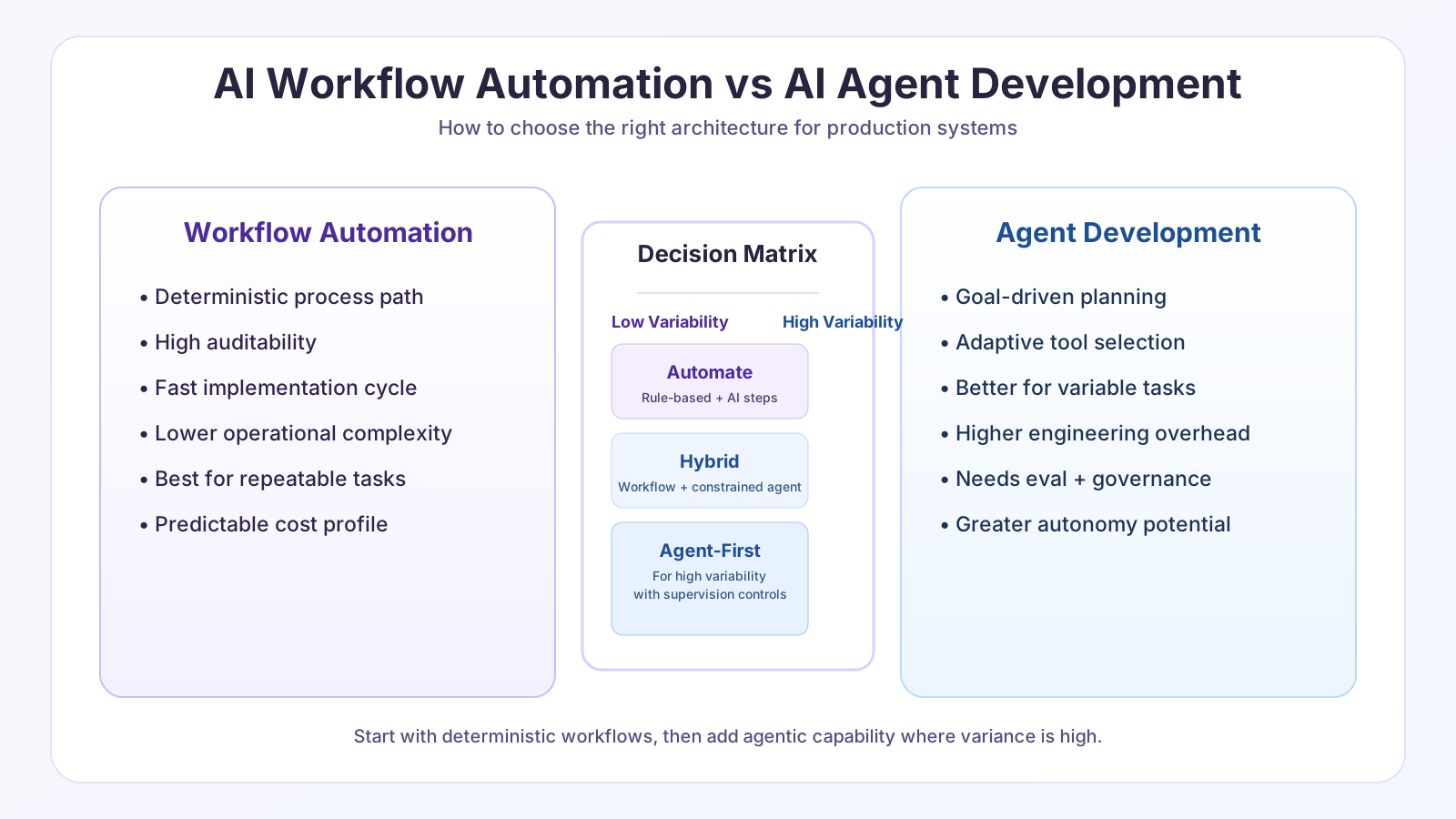
This guide breaks down the difference, when each pattern wins, and how to evaluate the right path for a real business system.
AI workflow automation is a deterministic process where predefined steps are orchestrated with AI at specific checkpoints.
The pipeline is explicit:
Typical examples:
The key property is control. Teams define process boundaries first, then insert AI where language understanding or classification improves speed and accuracy.
AI agent development focuses on autonomous goal completion, not fixed process execution.
Instead of following one strict path, an agent:
Typical examples:
The key property is adaptability. Agents are useful when variance is high and one static workflow would fail too often.
| Dimension | AI Workflow Automation | AI Agent Development |
|---|---|---|
| Process shape | Fixed, predefined sequence | Dynamic, goal-driven sequence |
| Change tolerance | Low to medium | High |
| Predictability | High | Medium |
| Auditability | Straightforward | More complex |
| Failure surface | Narrow and explicit | Broader and emergent |
| Time to first value | Fast (often 2-6 weeks) | Medium (often 6-12+ weeks) |
| Engineering overhead | Lower | Higher |
| Best for | Repetitive operations | Variable knowledge work |
A practical decision matrix can be built across three axes:
Use this heuristic:
Finance ops, compliance reporting, data enrichment, and customer routing where predictable rules dominate.
Stable backbone workflow with an agentic module for one or two judgment-heavy steps.
Multi-step research, exception handling, and operational triage where static flows break often.
AI strategy decisions are usually budget decisions in disguise. The model choice changes delivery economics.
| Factor | Workflow Automation | Agent Development |
|---|---|---|
| Typical discovery scope | Narrow process map | Broader goal and tool design |
| Build complexity | Low to medium | Medium to high |
| QA requirement | Scenario tests + deterministic checks | Evals + behavior testing + safety checks |
| Ongoing maintenance | Rules and prompts | Prompts, policies, tool reliability, eval tuning |
| Cost profile | Lower upfront, predictable | Higher upfront, variable over time |
For many teams, the financially safer path is:
This sequence protects budget and reduces unnecessary architecture risk.
When governance is strict, workflow automation usually fits better first.
Why:
Agentic systems can still be compliant, but controls must be stronger:
Regulated domains often begin with automation on core workflows, then introduce agents in non-critical pathways where supervised autonomy is acceptable.
Use a workflow orchestrator as the source of truth. Add AI modules as bounded workers.
Event -> Orchestrator -> AI Classifier -> Validation -> System Action -> Audit Log
Benefits:
Use a deterministic workflow for intake, policy checks, and final actions. Add an agent only for an exploratory middle step.
Trigger -> Policy Gate -> Agent Task -> Human/Rule Approval -> Action + Log
Benefits:
Use when the business problem truly requires adaptive reasoning and teams can sustain eval infrastructure.
Goal -> Planner Agent -> Tool Calls -> Evaluator -> Replan -> Completion
Prerequisites:
If a flow is stable, an agent often adds cost without increasing value.
Rebranding does not create adaptability. If the path is fixed, it is automation.
Both models need testing. Agentic systems need deeper behavior evaluation to avoid silent drift.
Every production AI system needs clear fallback behavior: retry, handoff, or defer.
Use this checklist before committing to architecture:
Interpretation:
A phased rollout outperforms big-bang launches.
Define current SLA, error rate, manual effort, and handoff points.
Ship one high-volume workflow with strict validation gates and human override.
Pilot agent behavior only where deterministic rules perform poorly.
Scale architecture based on proven impact in cycle time, cost per task, and accuracy.
This pattern prevents overbuilding and aligns technical scope with business value.
Decision quality improves when architecture choices are tied to specific operational contexts.
The pattern is consistent: if success depends on repeatable execution, automation delivers faster and safer value. If success depends on adaptive reasoning under uncertainty, agents can justify additional complexity.
Architecture decisions should be evaluated using measurable production outcomes, not demo quality.
| KPI | Why It Matters | Workflow Baseline Signal | Agent Baseline Signal |
|---|---|---|---|
| Task completion rate | Measures end-to-end reliability | Should stabilize quickly | Improves over eval iterations |
| Human intervention rate | Indicates operational burden | Low and predictable | Higher initially, then trends down |
| Median latency per task | Impacts user and team trust | Typically tighter variance | Higher variance across cases |
| Cost per completed task | Protects long-term unit economics | Usually predictable | Needs active routing and guardrails |
| Policy violation rate | Captures compliance risk | Low with hard validation gates | Requires strict governance checks |
A useful operating model is to set architecture-specific KPI thresholds before rollout. If thresholds are missed for two consecutive review cycles, teams should downgrade autonomy, tighten rules, or shift from agentic behavior back to deterministic workflow control until quality recovers.
For most teams, the highest-probability path is not "agents everywhere." It is:
That combination delivers speed now and flexibility later.
Build reliable, auditable workflows that reduce manual operations without adding fragile complexity.
Explore serviceDesign and ship production-grade AI agents with tool safety, evaluation harnesses, and clear governance controls.
Explore serviceUsually yes. Workflow automation uses fixed paths and bounded AI tasks, which reduces engineering and testing overhead in early implementation phases.
Agent development becomes valuable when process variability is high and teams need adaptive planning across multiple tools or systems.
Yes. A deterministic workflow backbone with a constrained agent module is a common and effective production pattern.
Workflow automation is usually the safer starting point because audit trails and policy controls are easier to enforce. Agent features can be added later with stronger governance.
AI workflow automation and AI agent development solve different problems. Treating them as interchangeable creates budget waste and delivery risk.
The best strategy is to match architecture to process reality, not to trend narratives. Start with deterministic workflows where possible, layer in agentic behavior where needed, and scale only after outcomes are measurable.
Teams that follow this approach generally ship faster, keep risk lower, and still preserve room for advanced autonomy over time.