AI Development
Software Engineering
From Prototype to Production: How to Ship What You Vibe-Coded

Codse Tech
March 8, 2026
Vibe coding is excellent for speed. It can move a product from idea to a working prototype in days, which is why it has become the default for startup experiments and internal tool pilots.
The issue is not prototype velocity. The issue is production reliability.
A vibe-coded prototype is usually optimized for one thing: proving value quickly. Production software is optimized for very different goals: safety, uptime, maintainability, predictable cost, and compliance.
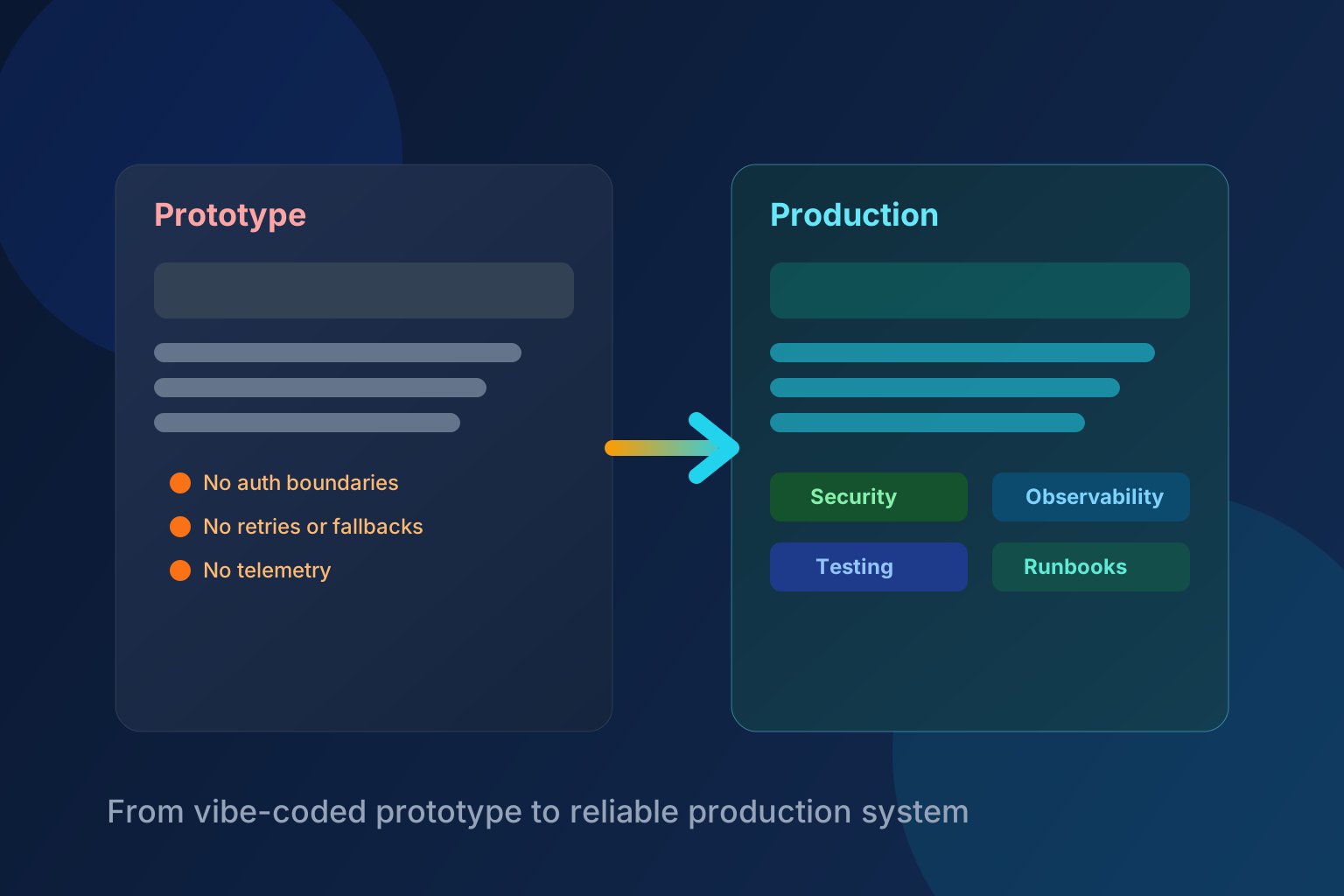
This guide explains the most common failure points when moving from prototype to production and provides a practical framework to close the gap.
Why vibe-coded prototypes fail in production
Most early prototypes are built around happy paths. Real users do not follow happy paths.
Once an application is exposed to real traffic, the following conditions appear quickly:
- malformed input and unexpected payloads
- concurrent usage spikes
- abuse attempts and credential stuffing
- upstream API failures and latency variance
- partial outages and data inconsistencies
- cost explosions caused by unbounded model calls
Production incidents rarely come from one big bug. They come from many small gaps that were acceptable in a prototype and unacceptable in live software.
The production readiness model: 10 gates
A practical way to ship faster without shipping risk is to treat production readiness as 10 gates. Each gate must be explicitly passed before launch.
| Gate | Core Question | Launch Risk if Skipped |
|---|---|---|
| Security | Can attackers exfiltrate data or execute unsafe actions? | Critical |
| Authentication & Authorization | Can the right user access only the right resources? | Critical |
| Data Validation | Can invalid or malicious input reach core logic? | High |
| Error Handling | Does failure degrade safely and predictably? | High |
| Testing | Is behavior verified beyond manual checks? | High |
| Observability | Can issues be detected and debugged quickly? | High |
| Performance | Is latency stable under real traffic? | Medium-High |
| Deployment | Can releases be rolled out and rolled back safely? | High |
| Monitoring & Incident Response | Can operations respond before users churn? | High |
| Cost Control | Are model and infra costs bounded under scale? | High |
1) Security: from permissive prototype to least privilege
Prototype code often uses broad API keys, minimal secret handling, and direct calls to privileged tools. That is acceptable in a sandbox and dangerous in production.
Production baseline:
- move all secrets to secure environment management
- use short-lived credentials where possible
- isolate tool permissions per feature
- sanitize user-provided prompts and files
- implement output filtering for high-risk actions
Before (prototype)
// Prototype: direct privileged action with no policy checks
await agent.run({
  task: userPrompt,
  tools: [dbAdminTool, fileSystemTool],
});
After (production)
// Production: policy-gated execution with scoped tools
const allowedTools = getToolsForRole(user.role);
const sanitizedTask = sanitizePrompt(userPrompt);

await agent.run({
  task: sanitizedTask,
  tools: allowedTools,
  policy: {
    requireHumanApprovalFor: ["write", "delete", "external_post"],
    redactPII: true,
  },
});
2) Authentication and authorization: identity before intelligence
Many vibe-coded MVPs assume a single trusted user. Production software must handle multiple users, roles, tenants, and permission boundaries.
Minimum controls:
- enforce strong session policies
- implement role-based or attribute-based access
- scope data access by tenant and ownership
- log every privileged action with actor identity
For AI applications, authorization should apply to tool execution, not only page access. A user who can view a dashboard should not automatically be able to trigger expensive or destructive agent workflows.
3) Data validation: trust nothing at boundaries
Prototype implementations often pass request payloads directly into core logic or model prompts. This creates both reliability and security problems.
Production requirements:
- schema-validate all inputs at API boundaries
- reject unknown fields and normalize data types
- apply size limits to text, files, and attachments
- enforce business constraints before model invocation
Before (prototype)
const result = await runWorkflow(req.body);
After (production)
const payload = WorkflowInputSchema.parse(req.body);
if (payload.documents.length > 5) {
  throw new Error("Too many documents. Maximum is 5.");
}

const result = await runWorkflow(payload);
4) Error handling: design for failure paths
Prototype code generally bubbles errors to the UI as generic failures. In production, each failure mode needs a defined behavior.
Examples:
- model timeout -> retry with backoff, then fallback response
- tool failure -> partial completion with user-safe explanation
- rate-limit hit -> queue and notify instead of dropping request
- validation error -> actionable message and correction hints
Error budgets and fallback strategy are a core part of AI user experience. If model calls are unstable, users need graceful degradation rather than opaque failure.
5) Testing: automate confidence, not just demos
Demo-driven development proves possibility. Production requires repeatability.
Testing stack for AI-enabled products:
- unit tests for deterministic business logic
- integration tests for API and database paths
- contract tests for third-party APIs
- regression tests for prompt and output structure
- end-to-end tests for critical user journeys
For AI-specific behavior, include evaluation sets for representative tasks and measure drift over time.
| Test Type | Prototype Habit | Production Standard |
|---|---|---|
| Unit | Optional | Required for core logic |
| Integration | Rare | Required for critical flows |
| E2E | Manual demo only | Automated on every release |
| AI Evaluation | Ad-hoc checks | Versioned eval dataset + thresholds |
6) Observability: logs, metrics, traces
Without observability, debugging production AI systems becomes guesswork.
Recommended baseline:
- structured logging with correlation IDs
- metrics for latency, error rate, token usage, and tool success
- distributed traces across API, model, and tool calls
- dashboards by feature and tenant
Core production SLO examples:
- p95 response time under 2.5 seconds for non-streaming endpoints
- error rate below 1% for user-facing requests
- model timeout rate below 0.5%
- token cost per successful workflow within target band
7) Performance: optimize the expensive path first
Prototypes typically optimize developer speed. Production must optimize user-perceived speed and infrastructure efficiency.
High-leverage improvements:
- stream partial responses instead of waiting for full completion
- cache retrieval and deterministic preprocessing stages
- batch low-priority background operations
- precompute embeddings and expensive transforms
- tune model and prompt size per task complexity
Performance work should target the dominant cost and latency path, not generic micro-optimizations.
8) Deployment: remove release fear
A prototype is often deployed manually. Production deployment should be automated, repeatable, and reversible.
Checklist:
- CI pipeline with tests and type checks
- environment parity across staging and production
- migration safety checks
- canary or phased rollout
- one-command rollback path
Deployment quality is a business metric. Faster, safer releases directly reduce incident recovery time and customer-visible downtime.
9) Monitoring and incident response: plan for bad days
If there is no runbook, every outage becomes improvisation.
What to implement before launch:
- alerting thresholds for errors, latency, and spend anomalies
- on-call ownership for each critical service
- severity definitions (SEV-1 to SEV-3)
- incident timeline and postmortem template
- known-failure runbooks with recovery steps
Teams that ship AI features successfully treat operations as part of product design, not as afterthought infrastructure.
10) Cost control: avoid scaling surprises
The most common post-launch AI incident is not downtime. It is unbounded cost.
Controls that work:
- per-request token limits
- per-user and per-tenant usage quotas
- model routing (smaller models for simple tasks)
- caching frequent queries and summaries
- hard budget alerts with automatic degradation mode
Before (prototype)
const response = await llm.generate({ model: "large-model", prompt });
After (production)
const model = selectModel({
  complexity: scoreComplexity(prompt),
  budgetTier: tenant.budgetTier,
});

const response = await llm.generate({
  model,
  maxTokens: 900,
  prompt,
  timeoutMs: 9000,
});
A practical 4-week production hardening plan
Week 1: Security and access boundaries
- close secret management gaps
- implement role and tenant checks
- enforce input schemas
- define high-risk action policies
Week 2: Reliability and quality
- add structured error taxonomy
- implement retries and fallback flows
- ship baseline test suite
- define release gates
Week 3: Visibility and operations
- add logs, metrics, and traces
- build operational dashboards
- configure alert routing and escalation
- publish first incident runbook
Week 4: Performance and unit economics
- profile high-latency endpoints
- add caching and streaming paths
- enforce token and usage budgets
- verify cost per workflow target
This phased approach keeps feature velocity while reducing launch risk.
Production readiness scorecard
Use this scorecard before launch:
| Domain | Score (0-5) | Minimum to Launch |
|---|---|---|
| Security | 4 | |
| Auth & Access | 4 | |
| Data Validation | 4 | |
| Error Handling | 4 | |
| Testing | 3 | |
| Observability | 3 | |
| Performance | 3 | |
| Deployment | 4 | |
| Monitoring | 3 | |
| Cost Control | 4 |
If any critical domain is below threshold, launch should pause until remediation is complete.
Common anti-patterns when shipping vibe-coded apps
- Treating production as a one-time checklist instead of an operating discipline.
- Relying on manual QA for AI behavior changes.
- Granting broad tool permissions because access control is "coming later."
- Skipping rollback paths for model, prompt, or policy updates.
- Tracking uptime but ignoring unit economics.
These anti-patterns create compounding risk and usually surface under growth, exactly when systems should be most stable.
Where to get implementation help
Teams that need to move fast can still ship production-grade systems by introducing engineering gates early. The highest ROI comes from fixing architecture and guardrails before user scale amplifies every gap.
For organizations moving from prototype to production, targeted support is available through vibe coding services and AI integration services, including security hardening, deployment systems, observability design, and cost optimization.
Vibe Coding Services
Ship your AI prototype to production with security, testing, and observability built in.
Explore serviceAI Integration Services
Full-stack AI integration — from architecture review to production deployment and monitoring.
Explore serviceFAQ
What does 'vibe coding to production' mean?+
It means converting rapidly generated prototype code into software that meets security, reliability, and operational standards for real users.
How long does production hardening usually take?+
For most teams, a focused 2-4 week hardening sprint is enough to address the highest-risk gaps before broader rollout.
Can the same prototype codebase be kept?+
Usually yes, but only after major changes in access control, validation, testing, observability, and deployment pipeline quality.
What is the biggest risk to shipping AI prototypes?+
Uncontrolled behavior under real-world load, especially when combined with weak security and missing cost guardrails.
Is vibe coding still useful for serious products?+
Yes. It is highly effective for discovery and rapid iteration. The key is pairing it with disciplined production engineering before launch.
Shipping fast and shipping safely are not competing goals. With explicit production gates, teams can keep prototype speed and deliver software that survives real usage.
vibe coding to production
ship ai prototype
production readiness checklist
ai software engineering
secure ai deployment