AI Development
Application Security
Engineering Guides
The Security Problem with Vibe-Coded Apps (and How to Fix It)

Codse Tech
March 13, 2026
The Security Problem with Vibe-Coded Apps (and How to Fix It)
Vibe coding has changed software delivery speed. Product teams can move from concept to prototype in days, and solo builders can ship early versions without a full engineering org.
The tradeoff is security quality. AI-generated code tends to over-optimize for functionality and under-specify security boundaries. In practice, that means higher defect density in authentication, validation, authorization, and secrets handling.
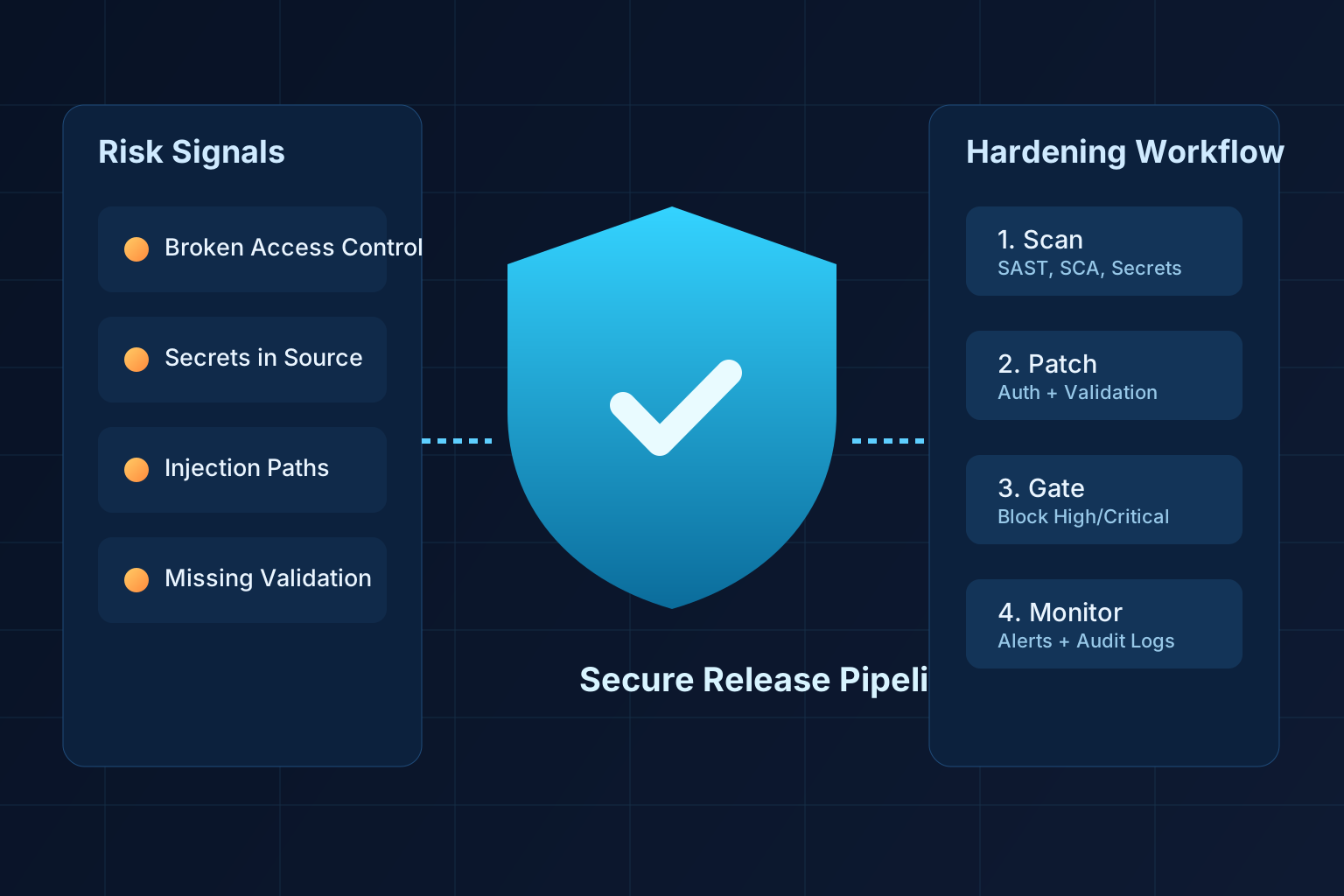
For teams shipping customer-facing software, this is now a business risk, not just a code quality issue. Security incidents create legal exposure, incident response cost, and direct trust loss.
Why vibe-coded apps have higher security risk
AI coding tools are effective at generating plausible code paths quickly. They are less reliable at enforcing architecture-specific security controls unless those controls are explicitly constrained in prompts, templates, and CI checks.
Common root causes:
- Missing threat model during prototype-to-production handoff
- No secure defaults in generated boilerplates
- Incomplete input validation and output encoding
- Over-permissive auth and role checks
- Secrets copied into source code or client bundles
- Insufficient dependency and container scanning
Security failures in this context are usually systemic. If one route has an authorization flaw, multiple routes often share the same pattern.
The most common vulnerabilities in AI-generated code
1. Broken access control
Generated endpoints frequently validate authentication but skip authorization. A user can be signed in and still access records from other tenants.
Fix: enforce tenant-aware policy checks at service boundaries and add integration tests for cross-tenant access attempts.
2. Injection vulnerabilities
Prompt-generated SQL and dynamic query construction often rely on string interpolation.
Fix: parameterize all queries, use query builders/ORM safeguards, and add static rules that block unsafe patterns at review time.
3. Insecure secret handling
API keys, tokens, and service credentials are often embedded in code samples and copied directly into production.
Fix: move all secrets to managed stores, rotate any exposed values, and add pre-commit + CI secret scanning.
4. Weak session and token controls
Token expiry, refresh logic, audience validation, and revocation checks are frequently incomplete.
Fix: use audited auth libraries, short-lived access tokens, rotating refresh tokens, and mandatory server-side revocation flows.
5. Insufficient input validation
Schema validation is either missing or only present in frontend forms.
Fix: validate every boundary server-side using strict schemas and reject unknown fields by default.
6. Overexposed logging and telemetry
Debug logs can include PII, prompts, model outputs, and credentials.
Fix: add log redaction rules, classify sensitive fields, and enforce retention + access controls.
AI-generated code security checklist for production
Use this checklist before any public release.
| Control Area | Minimum Production Standard | Validation Method |
|---|---|---|
| Authentication | Centralized auth with token rotation and revocation | Auth integration tests |
| Authorization | Resource-level and tenant-level policy checks | Negative tests + policy tests |
| Input validation | Strict schema validation on every API boundary | Contract tests |
| Output encoding | Context-aware encoding in templates and UI | XSS test suite |
| Secrets | No secrets in code, secrets in managed vault | Secret scan in CI |
| Dependencies | Pinned versions + vulnerability scanning | SCA pipeline |
| API protection | Rate limits, WAF rules, bot controls | Load and abuse tests |
| Observability | Security events, alert thresholds, traceability | SIEM/monitoring validation |
| Backup and recovery | Tested restore procedures and incident runbooks | Disaster recovery drill |
| Compliance | Data residency, audit logs, retention policy | Compliance checklist |
A practical remediation workflow for vibe-coded projects
Phase 1: Security triage (Day 1)
- Run SAST, dependency scanning, and secrets detection
- Identify internet-facing endpoints and privileged workflows
- Classify findings by exploitability and business impact
Phase 2: High-risk patch set (Days 2-3)
- Patch auth and authorization flaws first
- Remove embedded secrets and rotate credentials
- Add strict validation and sanitize output paths
Phase 3: Hardening baseline (Days 4-5)
- Add rate limiting and abuse detection
- Implement centralized security logging and alerts
- Introduce blocking CI gates for critical vulnerabilities
Phase 4: Release readiness (Day 6)
- Execute regression tests for auth, payments, and data flows
- Run a lightweight penetration test on critical endpoints
- Approve release only when critical/high findings are closed
Tooling stack for secure AI-assisted development
A lightweight stack that works for startups and product teams:
- SAST: Semgrep, CodeQL, or Snyk Code
- Dependency scanning: Dependabot + OSV/Trivy
- Secrets scanning: Gitleaks or TruffleHog
- DAST/API testing: OWASP ZAP or StackHawk
- Runtime monitoring: Sentry + cloud-native audit logs
The goal is not tool quantity. The goal is enforceable gates that block unsafe builds.
Cost impact: prevention vs incident response
Security investment is usually lower than post-incident cost.
| Scenario | Typical Cost Range (USD) | Notes |
|---|---|---|
| Preventive hardening sprint | $3,000-$12,000 | Includes scanning, auth hardening, and CI controls |
| Post-breach incident response | $25,000-$150,000+ | Forensics, legal, customer comms, remediation |
| Long-term trust and churn impact | Variable, often highest | Conversion and retention loss after breach disclosure |
For budget-conscious teams, secure-by-default architecture is usually the highest ROI engineering decision in the first release cycle.
Governance rules for teams using AI coding tools
- Require security acceptance criteria in every AI-generated task.
- Enforce code review for auth, payment, and data-layer changes.
- Block merges when critical/high findings are unresolved.
- Keep reusable secure templates for routes, middleware, and data access.
- Run periodic adversarial tests against top customer workflows.
Without these controls, velocity gains from vibe coding are offset by production risk.
Security review checklist for pull requests
Engineering leaders can reduce review variance by using a standard checklist for AI-assisted pull requests:
| Review Area | Reviewer Questions | Pass Criteria |
|---|---|---|
| AuthN/AuthZ | Does this change expand access scope? Are policy checks centralized? | No direct object references without ownership checks |
| Input handling | Are all request bodies and params schema-validated server-side? | Strict schemas, unknown fields rejected |
| Data layer | Are queries parameterized and tenant-scoped? | No raw string concatenation in queries |
| Error handling | Do errors avoid leaking internals and secrets? | Generic user errors, detailed secure logs |
| Secrets and config | Any credential or token in code, logs, or client payloads? | Zero plaintext secrets in repository |
| External calls | Are outbound calls bounded by timeout/retry/circuit limits? | Safe retry policy and failure fallback |
| Observability | Can this flow be audited in production? | Trace ID, security event logs, and alerts present |
Teams that operationalize this checklist typically reduce security-related rework during release windows.
CI/CD pipeline pattern for AI generated code security
A secure pipeline should fail fast on exploitable findings and still keep delivery speed practical.
Recommended sequence:
- Pre-commit checks for secrets, linting, and schema validation.
- Pull request checks for SAST, dependency risks, unit tests, and policy tests.
- Merge-to-main checks for integration tests, migration validation, and build attestation.
- Pre-production checks for DAST/API abuse tests and high-risk manual review.
- Post-deploy checks for anomaly detection, auth error spikes, and privilege escalation alerts.
A common anti-pattern is treating security tools as passive reporting. For AI-assisted codebases, blocking gates are essential because change volume is high and review fatigue appears quickly.
90-day hardening roadmap for teams adopting vibe coding
Most teams do not need a full security re-platform. A focused 90-day plan is usually enough to move from ad hoc checks to production reliability.
Days 1-30: establish baseline controls
- Inventory all internet-facing endpoints and privileged workflows
- Enforce managed secrets and key rotation policy
- Add schema validation and policy checks to critical routes
- Enable SAST + dependency scanning in CI for every PR
Days 31-60: close systemic gaps
- Add tenant-isolation regression tests for sensitive resources
- Introduce DAST scans for auth, injection, and abuse paths
- Define incident severity tiers and escalation runbooks
- Add alerting for unusual auth failures and token usage spikes
Days 61-90: operationalize security posture
- Build secure code templates for common endpoint types
- Add periodic attack simulation against top revenue workflows
- Track security KPIs in engineering dashboards
- Establish release governance with explicit security sign-off
This sequence keeps implementation manageable while materially reducing breach probability.
Metrics to track after hardening
Security programs improve faster when tied to measurable outcomes.
| KPI | Why it matters | Target Direction |
|---|---|---|
| Critical/high findings per release | Shows exploitability trend | Downward over time |
| Mean time to remediate (MTTR) | Indicates response efficiency | Reduce month over month |
| Unauthorized access test failures | Measures policy reliability | Move to zero |
| Secret leak incidents | Tracks credential hygiene | Zero tolerated |
| Security-related hotfixes post-release | Captures missed pre-release risks | Consistent decline |
| Vulnerable dependency age | Shows patch discipline | Keep within defined SLA |
These metrics help teams prove that AI-assisted velocity and security can coexist.
How to ship vibe-coded software safely
Vibe coding works best for discovery and acceleration. Production release still requires rigorous engineering controls.
A practical policy for 2026:
- Prototype fast with AI
- Harden before exposure
- Automate security checks in CI/CD
- Monitor continuously in production
This model preserves delivery speed while reducing the probability of security incidents.
Vibe coding services
Turn AI-generated prototypes into production-grade systems with testing, security hardening, and deployment pipelines.
Explore serviceAI integration services
Build secure AI features with robust access controls, evaluation, observability, and governance.
Explore serviceFAQ: vibe coding security in 2026
Why does AI-generated code have more security issues?+
AI tools optimize for plausible implementation speed, not threat-model completeness. Without explicit constraints and CI gates, critical controls can be omitted.
Can vibe-coded apps be made production-safe?+
Yes. Teams that add strict validation, policy-based authorization, secrets management, and automated security gates can safely ship AI-assisted code.
What is the first security step before launch?+
Perform a risk-ranked triage across authentication, authorization, secrets, and exposed endpoints. Patch critical findings before feature expansion.
Which security checks should block deployment?+
Critical and high-severity SAST findings, exposed secrets, vulnerable dependencies without mitigation, and failed authorization regression tests should all block release.
How often should security checks run for AI-assisted projects?+
Run checks on every pull request and in nightly deeper scans. Pair this with production monitoring to detect drift and new attack patterns.
vibe coding security
AI generated code security
application security checklist
secure software development
SAST
OWASP
production hardening