AI Development
Software Engineering
Product Engineering
From Prototype to Production: How to Ship What You Vibe-Coded

Codse Tech
March 8, 2026
From Prototype to Production: How to Ship What You Vibe-Coded
Vibe coding is excellent for speed. Product teams can move from idea to clickable flow in days and validate demand before spending months in delivery.
The problem appears at launch time. A prototype that looks finished can still fail under real traffic, real users, and real compliance requirements.
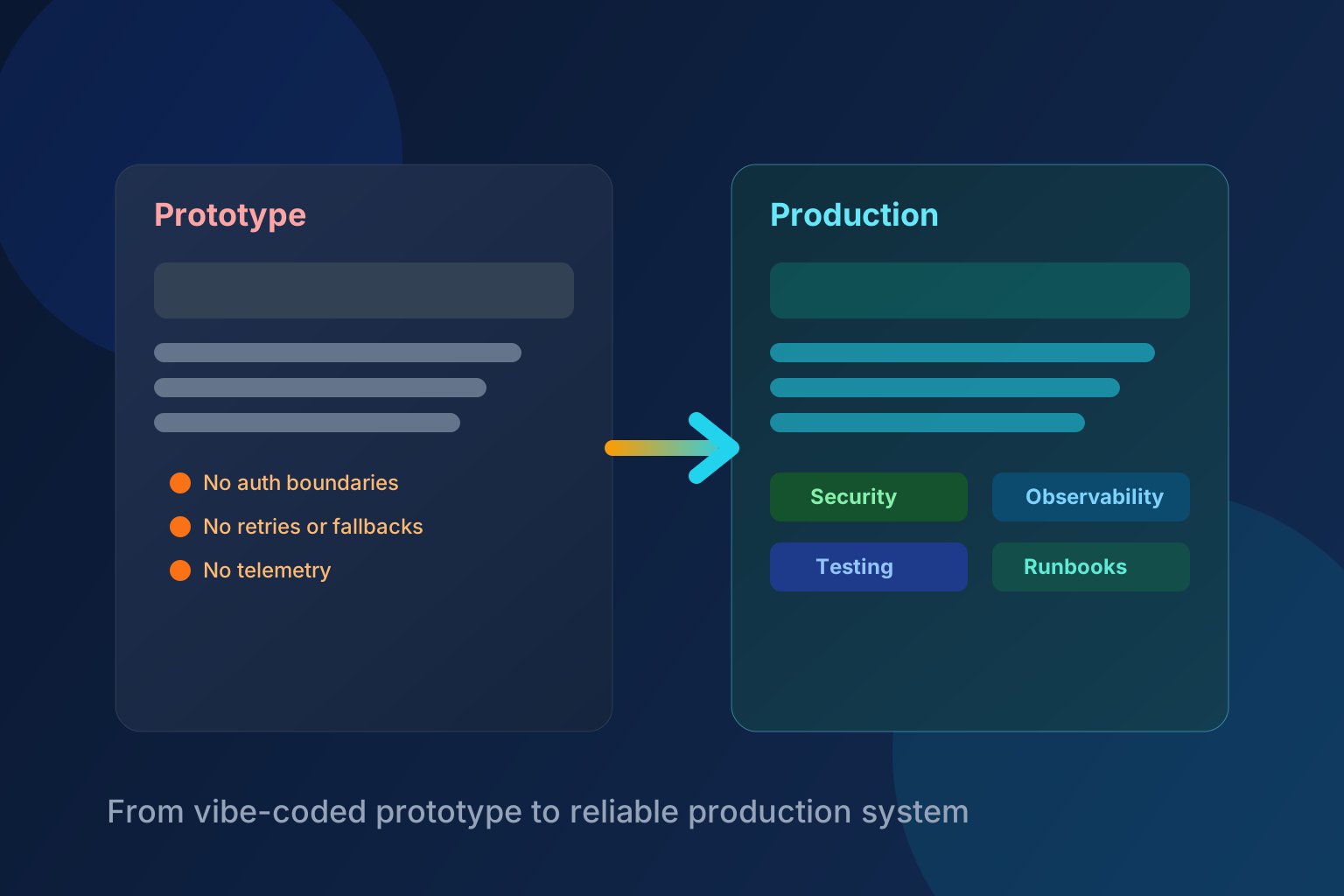
This guide explains how to move from vibe coding to production with a practical checklist used by engineering teams shipping AI-enabled software in 2026.
Why vibe-coded prototypes fail in production
Most prototype failures come from one root cause: the code optimized for speed, not reliability.
Prototype code usually has these characteristics:
- optimistic assumptions about network and user behavior
- incomplete authorization boundaries
- weak input validation and error handling
- no observable metrics for latency, cost, or failure rate
- manual release process with no rollback strategy
Production software requires the opposite. It must stay safe, predictable, and measurable under edge cases.
For teams planning larger launches, this checklist pairs well with vibe coding services and AI integration services, where production-readiness controls are built into delivery from day one.
The 10 things that break between prototype and production
1. Security boundaries
Prototype behavior:
- API routes trust client-side claims
- secrets are loaded in broad scopes
- role checks happen in UI only
Production requirement:
- server-side authorization on every privileged action
- scoped secrets with rotation policy
- role-based access control enforced in middleware and service layer
Minimum hardening tasks:
- add route-level auth guards
- enforce least-privilege service tokens
- run dependency and secret scans in CI
2. Error handling and fallbacks
Prototype behavior:
- unhandled promise rejections
- generic "Something went wrong" toasts
- no retry strategy
Production requirement:
- typed error classes with clear user-safe messages
- retries with jitter for transient failures
- fallback paths for model timeouts and tool failures
Minimum hardening tasks:
- normalize error contracts across API handlers
- define retry budgets and circuit-breaker limits
- add graceful fallback copy in critical user flows
3. Automated testing
Prototype behavior:
- manual click testing only
- no regression suite
- no confidence during refactors
Production requirement:
- unit tests for core business logic
- integration tests for data boundaries
- end-to-end tests for purchase, onboarding, and key AI workflows
Minimum hardening tasks:
- protect critical paths with CI test gates
- add fixtures for model and tool responses
- include failure-path tests, not only success paths
4. Observability and alerting
Prototype behavior:
- console logs in development
- no production traces
- outages discovered by customer complaints
Production requirement:
- structured logs with request correlation IDs
- latency, error-rate, and saturation dashboards
- alert thresholds with escalation rules
Minimum hardening tasks:
- instrument API + worker layers
- trace model calls and external tool calls
- alert on SLO breaches, not only process crashes
5. Data validation and schema discipline
Prototype behavior:
- unchecked JSON payloads
- implicit type coercion
- fragile parsing for model output
Production requirement:
- strict runtime schema validation
- explicit versioned payload contracts
- parse-then-validate for all model outputs
Minimum hardening tasks:
- introduce schema validators for every entry point
- reject malformed payloads with typed errors
- lock contract versions before public release
6. Authentication and session control
Prototype behavior:
- long-lived sessions without revocation
- weak tenant separation
- client-side identity assumptions
Production requirement:
- short-lived tokens and secure refresh flow
- strict tenant scoping at query level
- auditable login/session events
Minimum hardening tasks:
- implement token expiry and rotation
- enforce tenant IDs in read/write queries
- add admin controls for forced logout and session revoke
7. Performance under load
Prototype behavior:
- no load testing
- N+1 query patterns
- uncached expensive model operations
Production requirement:
- defined p50/p95 latency budgets
- queueing and back-pressure for spikes
- caching strategy for repeated requests
Minimum hardening tasks:
- run synthetic load tests before launch
- profile hotspots and remove N+1 behavior
- cache deterministic outputs where safe
8. Deployment and rollback safety
Prototype behavior:
- manual deploy from laptop
- no migration safeguards
- rollback means "patch quickly"
Production requirement:
- versioned CI/CD pipeline
- migration checks and backward compatibility
- deterministic rollback plan tested in advance
Minimum hardening tasks:
- define blue/green or canary rollout policy
- gate deploys on build + test + policy checks
- script rollback and verify at least once per release cycle
9. Monitoring and on-call readiness
Prototype behavior:
- no ownership for incidents
- no incident response process
- no service status communication
Production requirement:
- clear ownership matrix per service
- runbooks for top failure modes
- incident timeline and postmortem discipline
Minimum hardening tasks:
- document first-response runbooks
- assign weekly incident owner
- capture incident metrics for trend analysis
10. Cost control and model governance
Prototype behavior:
- no token budget limits
- expensive models on all routes
- no usage visibility by customer segment
Production requirement:
- per-feature cost attribution
- model routing by task criticality
- hard spend guardrails and usage anomaly alerts
Minimum hardening tasks:
- tag every model request with product context
- route low-risk tasks to lower-cost models
- cap spend by workspace, account, or feature tier
Before/after examples: vibe-coded vs production-grade
Example A: API handler
| Dimension | Vibe-coded prototype | Production-grade implementation |
|---|---|---|
| Input validation | Accepts raw payloads | Schema validation with explicit failure reasons |
| Auth | Assumes client token is valid | Server-side token verification + role checks |
| Error handling | Catches all errors as generic 500 | Typed error mapping and safe client messages |
| Logging | Console output only | Structured logs + correlation IDs |
| Cost tracking | None | Feature and tenant cost tags on model calls |
Example B: AI response flow
| Dimension | Vibe-coded prototype | Production-grade implementation |
|---|---|---|
| Model output parsing | Trusts free-form text | Uses structured output schema + validator |
| Fallback behavior | Fails closed with error toast | Retry budget + fallback model + safe default |
| Observability | No trace context | Full trace across prompt, model, and tool chain |
| Abuse prevention | No limits | Rate limiting and abuse detection policies |
These differences decide whether launch week feels stable or chaotic.
A practical production-readiness sequence (14-day plan)
Days 1-2: Security and data boundaries
- lock auth and tenant isolation
- implement runtime validation
- block unsafe routes and clean legacy permissions
Days 3-4: Error contracts and fallback logic
- define typed errors
- set retry and timeout policy
- wire user-safe messages for degraded modes
Days 5-7: Test coverage on critical paths
- add integration tests for top revenue flows
- add end-to-end tests for onboarding and conversion paths
- require test gates before deploy
Days 8-9: Observability and dashboards
- add metrics and traces
- define SLOs
- configure actionable alerts
Days 10-11: Load and performance tuning
- run load tests at expected launch traffic
- tune bottlenecks and cache strategy
- verify background queue behavior under spikes
Days 12-14: Release engineering and runbooks
- finalize CI/CD policies
- test rollback procedures
- publish incident runbooks and on-call ownership
SEO and go-to-market advantage of production quality
Production quality is not only a reliability goal. It is also a growth advantage.
When systems are stable:
- conversion rates improve because critical flows fail less often
- paid acquisition waste drops because fewer users churn at onboarding
- support burden decreases because issue categories become predictable
- organic discovery improves because technical quality supports faster pages and better UX signals
That is why "vibe coding to production" is becoming a buying criterion for founders evaluating AI delivery partners.
Production-readiness checklist (copy into project docs)
- Server-side auth checks enforced on all privileged routes
- Runtime schema validation on all external inputs
- Typed error contracts and user-safe failure messages
- Unit + integration + end-to-end tests for critical flows
- Structured logs, traces, dashboards, and alert policies
- Load tests completed and latency budgets documented
- CI/CD release gates and tested rollback scripts
- Runbooks published for top 5 incident classes
- Token and model spend guardrails configured
- Internal owner assigned for each production service
Production readiness scorecard (quick audit)
Teams preparing a release can use this simple scoring model to estimate launch risk.
Assign each category a score from 0 to 5:
0= missing3= partially implemented5= complete and tested
| Category | Score (0-5) | Notes |
|---|---|---|
| Security and access control | RBAC, secret scopes, tenant isolation | |
| Input and output validation | Runtime schemas, structured model outputs | |
| Automated testing | Unit, integration, end-to-end coverage | |
| Observability | Logs, traces, metrics, alert routing | |
| Performance and load safety | p95 targets, queueing, caching | |
| Deployment and rollback | CI gates, migration checks, rollback rehearsal | |
| Incident response readiness | Runbooks, ownership, escalation policy | |
| Cost governance | Feature-level token tracking and spend limits |
Interpretation:
0-19: Launch risk is high; production release should be delayed.20-29: Launch risk is moderate; release only with strict traffic controls.30-40: Launch risk is low; release is generally ready with active monitoring.
Reference architecture for shipping AI prototypes safely
The most reliable pattern in 2026 separates delivery into four layers:
Experience layer: web or mobile frontend with strict view models and resilient UX states.Application layer: API handlers and orchestrators that enforce auth, validation, and feature policy.Intelligence layer: model gateway, prompt templates, tool adapters, and evaluation hooks.Operations layer: telemetry, release controls, and incident automation.
This architecture keeps fast iteration possible while reducing blast radius when something fails.
Experience layer requirements
- explicit loading, success, and degraded states for every AI interaction
- idempotent form submissions to prevent duplicate side effects
- deterministic rendering for partially streamed responses
Application layer requirements
- central policy checks before model or tool invocation
- strict payload contracts between frontend, API, and workers
- request-level correlation IDs passed through all downstream services
Intelligence layer requirements
- model routing policy by quality, latency, and budget
- schema-enforced outputs for machine-consumed fields
- controlled tool-permission matrix by role and environment
Operations layer requirements
- release gating tied to objective quality checks
- automatic rollback criteria based on SLO violations
- incident communication workflow with timestamps and owners
Common anti-patterns that block production launches
"The demo worked once" release decision
A working demo is not evidence of repeatability. Production readiness requires repeatable results under varied inputs and failure modes.
"Observability can be added later"
No telemetry means no diagnosis. Without traces and correlated logs, incident response depends on guesswork and slows recovery.
"All requests can use the best model"
That choice creates immediate budget volatility. Production systems need model tiering and usage ceilings from day one.
"Manual deploys are faster"
Manual deploys are faster until rollback is needed. At scale, lack of automation increases outage duration and raises release anxiety.
Vibe Coding Services
Turn your AI prototype into production-grade software with a structured hardening sprint.
Explore serviceAI Integration Services
End-to-end AI integration — architecture, deployment, observability, and cost governance.
Explore serviceFAQ: vibe coding to production
What does 'vibe coding to production' mean?+
It means taking quickly generated prototype code and hardening it for reliability, security, observability, and maintainability before exposing it to real customers.
How long does it take to productionize a vibe-coded app?+
For a focused MVP, a dedicated hardening sprint often takes 10 to 20 working days, depending on domain risk, compliance requirements, and integration depth.
What is the most common reason AI prototypes fail after launch?+
Insufficient operational controls. Teams often optimize for feature velocity but skip structured validation, telemetry, and cost governance.
Is vibe coding still useful if production hardening is required?+
Yes. Vibe coding is valuable for discovery and early validation. The key is to treat it as phase one, not the final engineering state.
Which metrics should be tracked before launch?+
Track p95 latency, API and tool-call error rate, failed auth attempts, unit economics by feature, and time-to-recovery for incident drills.
Should production hardening happen before or after customer testing?+
Initial customer signal can come from prototype usage in controlled conditions. Broad release should wait until production controls are in place.
When to bring in external engineering support
An external production-readiness partner becomes useful when one or more of these are true:
- launch date is fixed and internal bandwidth is limited
- platform risk is high due to regulated data or financial workflows
- prototype logic must be rewritten with strict architecture boundaries
- incident response and observability are not yet operational
For companies in this stage, a scoped stabilization engagement can reduce release risk faster than extending ad hoc prototype work.
Final takeaway
Vibe coding remains the fastest way to prove an idea. Production engineering is the discipline that protects revenue, trust, and margins.
Teams that ship reliably treat prototype speed and production rigor as two different phases with different quality bars.
For organizations moving from demo momentum to market launch, a production-readiness sprint is usually the highest-leverage investment before scaling traffic.
Need a fast assessment before launch? Review the vibe coding service for prototype stabilization or request a broader AI integration services plan for production rollout.
vibe coding to production
ship ai prototype
production readiness checklist
ai app reliability
software hardening