AI Development
Infrastructure
MCP
MCP Servers: The New API Economy for AI Applications

Codse Tech
March 9, 2026
MCP servers are quickly becoming the connective layer between language models and production systems. As AI applications move from demos to core workflows, teams need a secure and standardized way to connect models to tools, databases, and APIs. That is exactly where Model Context Protocol (MCP) changes the game.
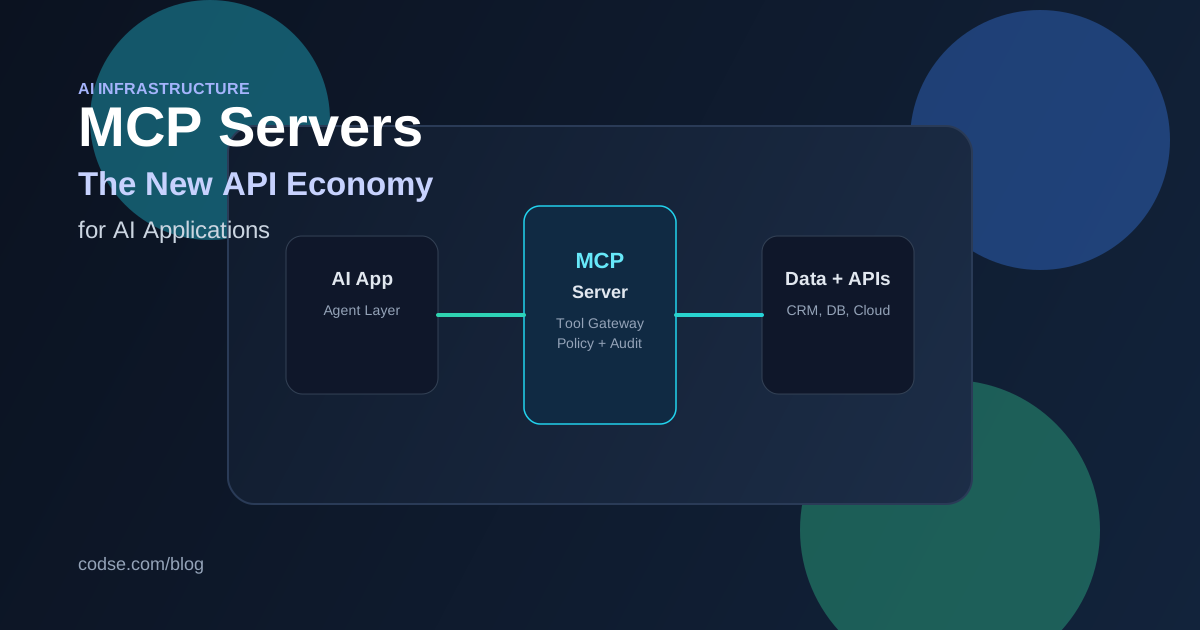
This guide explains why MCP servers matter, how they reshape the API economy, and how to build one with FastMCP for real production use.
What is an MCP server?
An MCP server is a protocol-compliant service that exposes tools and resources to AI clients in a structured, discoverable format. Instead of hardcoding every integration into prompt logic, AI applications can call standardized capabilities from MCP servers.
In practical terms, an MCP server does three important jobs:
- Declares available tools and inputs in a machine-readable format.
- Executes safe tool calls against internal or external systems.
- Returns structured outputs back to the AI client.
The result is a cleaner separation between reasoning (handled by models) and execution (handled by trusted tool infrastructure).
Why MCP is becoming the new API economy for AI applications
Traditional APIs were designed for deterministic code calling deterministic endpoints. AI applications are different. They require dynamic tool discovery, context-aware calls, and control layers for safety and cost.
MCP introduces a standard contract for that new reality.
1) Standardization reduces integration friction
Before MCP, every team built custom glue code for model-to-tool communication. That created duplicated effort and brittle implementations. With MCP, AI clients can consume a common interface across many servers.
This lowers onboarding time for new tools and improves portability across model providers and agent frameworks.
2) Tool ecosystems become composable
The API economy expanded because reusable APIs accelerated product development. MCP does the same for AI-native products.
Teams can combine multiple MCP servers for:
- Browser automation
- Documentation retrieval
- Cloud infrastructure actions
- Database querying
- Source control workflows
Instead of writing one-off adapters, teams compose capabilities as reusable infrastructure.
3) Governance becomes explicit
Production AI systems need policy controls. MCP server boundaries make it easier to enforce those controls:
- Per-tool permissions
- Input validation
- Audit logs
- Rate limits
- Role-aware access
That governance layer is often the difference between a safe deployment and a risky prototype.
Core MCP architecture for production teams
A production-ready MCP stack generally includes four layers:
AI client layer
This is the application that runs prompts, plans tool calls, and orchestrates workflows. It can be a coding assistant, internal automation tool, customer-facing copilot, or multi-agent backend.
MCP server layer
This layer exposes tools, validates requests, and executes operations. Each server should own a clear domain boundary such as CRM, billing, analytics, or document retrieval.
Integration layer
The integration layer wraps existing APIs, SDKs, databases, or event systems. It should normalize errors and return consistent structured outputs.
Control and observability layer
This includes authentication, authorization, tracing, logging, and cost controls. Without this layer, scale creates operational risk quickly.
How to build an MCP server with FastMCP
FastMCP is one of the fastest paths to shipping a compliant server. The exact package and runtime choices can vary, but the implementation pattern remains consistent.
Step 1: Define the domain and scope
Start with a narrow domain. A good first server usually handles one workflow family end-to-end.
Examples:
support-mcp: ticket lookup, account lookup, response draftingsales-mcp: lead retrieval, pipeline updates, activity summariesops-mcp: deployment status, incident lookup, release notes generation
Avoid building a mega-server first. Smaller domain servers are easier to secure, test, and scale.
Step 2: Define strongly typed tools
Each tool should have explicit input and output schemas. Keep tools atomic and composable.
Good example patterns:
search_customer_by_email(email)get_invoice_status(invoice_id)list_open_incidents(service, severity)
Avoid ambiguous tools like run_any_query in early versions. Broad tools reduce control and increase misuse risk.
Step 3: Add policy guards before rollout
Guardrails should exist before first production traffic:
- Reject malformed or oversized input payloads.
- Block high-risk actions without approval.
- Restrict write actions by role and environment.
- Add per-user and per-tool rate limits.
- Record every tool invocation with trace IDs.
Step 4: Return structured, concise outputs
Tool outputs should be JSON-like and predictable. Include fields the model can reason with, and avoid noisy free text.
Strong output design improves:
- Reasoning reliability
- Retry behavior
- Downstream analytics
- Cost efficiency
Step 5: Add offline evaluation tests
Before launch, run test suites that cover:
- Happy-path calls
- Input edge cases
- Permission failures
- Timeout and retry behavior
- Cost thresholds per workflow
This creates a baseline for safe iteration.
Example FastMCP implementation skeleton
The following minimal structure can be adapted to most domains:
from fastmcp import MCPServer

server = MCPServer(name="sales-mcp")

@server.tool("get_lead")
def get_lead(lead_id: str) -> dict:
    # validate input, call CRM API, return structured data
    return {"lead_id": lead_id, "status": "qualified"}

@server.tool("update_lead_stage")
def update_lead_stage(lead_id: str, stage: str) -> dict:
    # enforce policy checks before write operations
    return {"ok": True, "lead_id": lead_id, "stage": stage}

if __name__ == "__main__":
    server.run()
In production, this skeleton should be extended with authentication middleware, telemetry, robust error mapping, and policy enforcement for sensitive actions.
Popular MCP servers teams are testing in 2026
The ecosystem is moving quickly, but several categories are already proving high value.
Playwright MCP servers
Playwright-backed MCP servers enable browser automation tasks for QA, testing, and validation workflows. They are useful for AI-assisted regression checks and UI status verification in CI systems.
Context and documentation servers
Documentation-aware servers allow models to retrieve current technical docs and internal runbooks. This reduces hallucinations in engineering workflows and improves onboarding assistants.
Cloud and infrastructure servers
Cloud-oriented MCP servers (including AWS-focused patterns) expose controlled operational tools for deployment checks, environment health, and cost visibility.
Data and warehouse servers
Database-backed MCP servers enable controlled query and reporting workflows. A strong pattern is read-first access with strict query templates and transparent logging.
Developer workflow servers
Git provider, ticketing, and CI/CD servers are increasingly connected through MCP to power coding assistants that can inspect issues, propose fixes, and validate changes under guardrails.
Enterprise adoption trends shaping MCP strategy
Enterprise teams evaluating MCP server development are converging on similar patterns.
Trend 1: Domain-oriented server boundaries
Rather than one centralized server, organizations are moving to domain-specific MCP servers with clear ownership by platform or product teams.
Trend 2: Read-first rollout models
Many teams launch with read-only tools to minimize risk, then progressively enable write operations with policy gates and human approvals.
Trend 3: Observability as a launch requirement
Tool-call traces, latency metrics, token cost per workflow, and error categorization are treated as mandatory dashboards from day one.
Trend 4: Protocol strategy over provider lock-in
Organizations are using MCP to keep integration layers portable, reducing long-term coupling to a single model vendor.
Trend 5: Security and compliance alignment
Security teams are now involved earlier in AI projects. MCP server boundaries make it easier to map controls to SOC 2, HIPAA, GDPR, or internal governance requirements.
Cost model: why MCP can reduce long-term AI integration costs
MCP server architecture can cut delivery and maintenance cost in three ways:
- Reuse: one server supports multiple AI clients and workflows.
- Stability: standardized interfaces reduce brittle prompt glue code.
- Visibility: better telemetry reduces runaway API usage and debugging time.
Teams still need to budget for platform engineering, but the cost curve is more predictable than ad-hoc integrations.
Common mistakes when teams build MCP servers
Over-scoping the first release
Trying to cover every workflow in v1 creates fragile servers and unclear ownership. Start narrow, prove value, then expand.
Treating tool outputs as unstructured text
Unstructured outputs increase model confusion and reduce determinism. Prefer typed, concise payloads.
Skipping authorization at tool level
Global auth is not enough. Sensitive tools require granular permission checks.
Ignoring test and replay workflows
Without replayable traces and offline tests, regression risk rises with every change.
Missing internal documentation
Each tool should have a plain-language policy doc and an owner. This avoids confusion during incidents and compliance reviews.
Implementation checklist: build MCP server the right way
Use this checklist before production launch:
- Define one domain-focused MCP server scope.
- Implement explicit tool schemas and validation.
- Add authentication and role-based authorization.
- Enforce rate limits and budget controls.
- Add structured logging and distributed tracing.
- Build offline eval tests and replay workflows.
- Launch read-only first, then progressively enable writes.
- Document each tool's policy and ownership.
Where MCP fits in a broader AI integration roadmap
MCP is not a replacement for product architecture, but it is becoming a key infrastructure layer for AI-native applications.
A practical roadmap for most teams looks like this:
- Define high-value AI workflow candidates.
- Build one domain MCP server with strict guardrails.
- Connect a single AI client and measure outcomes.
- Expand into additional domains after reliability targets are met.
- Standardize governance and observability across the MCP fleet.
Reference architecture: from single server to MCP platform
Many teams begin with one MCP server and quickly discover cross-team demand. A staged architecture helps keep growth manageable.
Phase 1: single-domain pilot
Start with one domain and one AI client. Keep the blast radius small.
- One MCP server
- One read-first toolset
- One evaluation harness
- One owner team
This phase validates business value and exposes policy gaps before broader rollout.
Phase 2: multi-domain expansion
After pilot success, additional domains can be introduced:
- CRM and revenue operations
- Support and customer success
- Analytics and reporting
- Dev tooling and incident response
At this stage, platform conventions matter: standard logging shape, shared auth model, and reusable policy templates.
Phase 3: centralized platform controls
As the server count grows, platform-level controls become essential:
- Unified service registry for MCP endpoints
- Centralized policy engine for sensitive operations
- Shared telemetry and cost dashboards
- Environment-aware routing (dev, staging, production)
This structure lets product teams ship quickly while security and platform teams maintain control.
Performance and reliability patterns for MCP server development
The protocol standard solves integration consistency, but production reliability still depends on implementation quality.
Latency control
To keep end-user experience stable:
- Cache frequently requested read-only tool results.
- Use targeted timeout budgets per tool type.
- Return partial results when full responses are delayed.
- Apply circuit breakers for unstable downstream systems.
Retry strategy
Retries should be selective. A safe baseline:
- Retry transient network failures once or twice with jitter.
- Do not retry non-idempotent writes without explicit safeguards.
- Include clear error classes to guide client behavior.
Concurrency and backpressure
AI workflows can burst unexpectedly. Protect systems with:
- Queue limits per user and per tenant
- Worker pool ceilings
- Graceful degradation for non-critical tools
- Priority tiers for high-value workflows
Versioning strategy
Tool schemas will evolve. Keep compatibility predictable:
- Version tool contracts explicitly.
- Publish deprecation windows before breaking changes.
- Maintain migration docs for client teams.
Without versioning discipline, MCP adoption can stall due to integration fear.
Security model: zero-trust defaults for MCP servers
MCP infrastructure should follow zero-trust principles by default.
Identity and authentication
Each request should include verifiable identity context. Recommended controls:
- Service-to-service authentication with short-lived credentials
- User-context propagation when actions are user-initiated
- Strict separation between machine identity and end-user identity
Authorization
Authorization should be evaluated at tool and action level, not just endpoint level.
High-sensitivity operations should require:
- Role checks
- Environment checks
- Optional human approval for write actions
Data protection
Sensitive payloads require layered controls:
- Redaction of secrets and PII in logs
- Encryption in transit and at rest
- Data minimization for tool responses
If a model only needs status and summary fields, avoid returning full records.
MCP server KPIs that indicate real business impact
Technical metrics matter, but decision-makers also need business visibility. Track both.
Product and operations KPIs
- Automation completion rate
- Human handoff rate
- Mean time to task completion
- Incident rate related to tool actions
Financial KPIs
- Cost per successful workflow
- Cost per active tenant
- Cost trend by tool category
- Savings versus legacy manual process
Quality KPIs
- Factual consistency score
- Tool call success rate
- Policy violation frequency
- Regression rate after releases
A mature MCP program links these KPIs to roadmap decisions and budget planning.
AI Agent Development
Production AI agents with MCP integration, tool orchestration, and governance built in.
Explore serviceAI Integration Services
Connect AI systems to your existing tools and data sources with reliability and compliance controls.
Explore serviceFAQ: MCP servers for product and engineering teams
Is MCP only useful for coding assistants?+
No. Coding assistants are an early adoption category, but MCP also supports support automation, operations copilots, analytics assistants, and customer-facing AI features.
How is MCP different from direct API integration?+
Direct integration can work for small scope. MCP becomes valuable when teams need protocol-level consistency, multi-tool orchestration, and centralized governance across many AI workflows.
When should a team build a custom MCP server?+
A custom server is usually justified when existing servers cannot satisfy required policies, domain logic, or system-specific integrations. High-regulation environments often need custom implementations.
Can MCP servers support regulated industries?+
Yes, if implementation includes auditability, least-privilege access, role-based controls, data minimization, and documented policy enforcement aligned with compliance requirements.
What is the fastest way to start?+
Choose one read-first workflow with clear ROI, build a narrow FastMCP server, instrument it properly, and run it with explicit evaluation gates before scaling scope.
Final takeaway
MCP servers are turning tool integration into a standardized layer for AI systems, similar to how APIs standardized service integration in earlier software eras. For teams building serious AI products, MCP server development is quickly moving from optional experimentation to core infrastructure strategy.
For organizations planning production adoption, the fastest path is focused scope, explicit policies, and measurable quality gates from day one.
Need implementation support for production-ready MCP infrastructure? Explore MCP server development services and AI agent development services to accelerate delivery with strong reliability, governance, and cost controls.
mcp server
model context protocol
build mcp server
fastmcp
ai integration
ai agent development