f(x) = σ(Wx + b)∇loss.backward()model.predict(x)torch.nn.Transformerawait fetch('/api')git rebase -i HEAD~3docker compose up -dconsole.log('here')∫f(x)dx∑(i=0→n)O(log n)fn main() -> Result<>SELECT * FROM userskubectl get pods{ ...state, loading }npm run build && deploypipe(filter, map, reduce)env.PROD=true
Codse logo
  • Services
  • Work
  • OpenClaw
  • Blog
  • Home
  • Services
  • Work
  • OpenClaw
  • Blog

Get in touch

Let's build something

Tell us what you're working on. We'll scope it within 48 hours and propose a sprint or retainer that fits.

Quick links

ServicesWorkOpenClawBlog

Also find us on

GithubFacebookInstagram
Codse© 2026 Codse
Software · AI Agents
Healthcare
AI Development
Compliance

Healthcare AI Software Development Compliance Checklist for 2026

Codse Tech
Codse Tech
March 2, 2026

Nobody cares how accurate your healthcare AI model is if it can't pass a compliance review. That's the reality of building in this space right now.

And the review isn't simple. US organizations need HIPAA-aligned controls. Australian teams have to satisfy the Privacy Act and Australian Privacy Principles (APPs). NDIS providers need evidence handling and incident governance on top of that. If your system can't demonstrate these controls clearly, you're carrying real legal and financial risk.

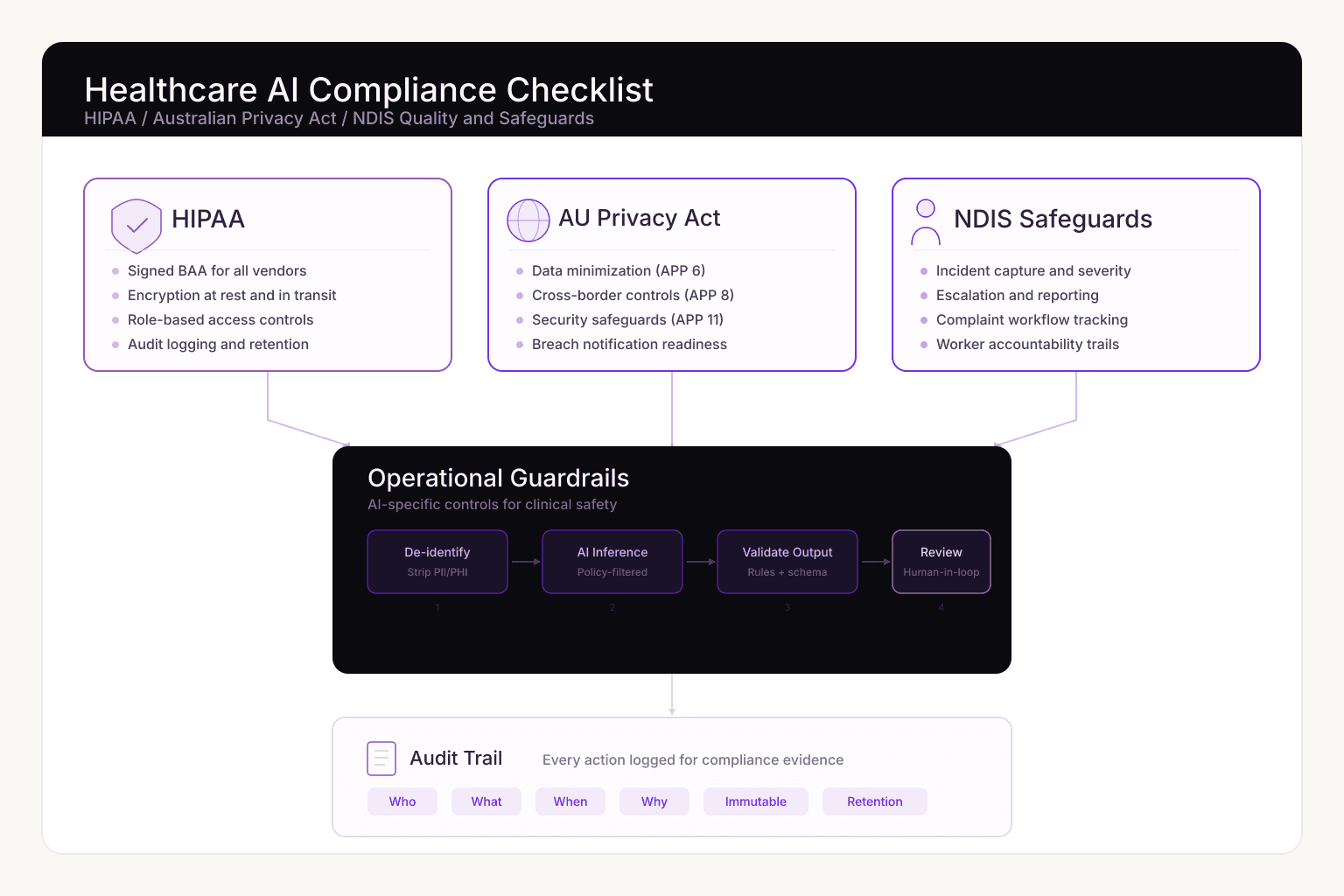
Infographic hero showing a healthcare AI compliance checklist with HIPAA controls, Australian Privacy Act safeguards, NDIS safeguards, and operational guardrails such as de-identification and audit trails.

We put this checklist together for product leads and engineering teams who are either building healthcare AI internally or evaluating partners to do it.

Why healthcare AI compliance is now a product requirement

We keep seeing the same pattern: teams build the AI features first, then try to bolt on compliance before launch. It rarely works. In healthcare, compliance needs to be baked into the architecture from the start.

Here's why:

  • You're handling data that's far more sensitive than typical SaaS.
  • AI models are probabilistic, so you need explicit review and override paths built in.
  • Regulators want evidence of working controls, not just a policy document.
  • Healthcare buyers are now asking about your data handling architecture during the first call, not the last.

The approach that works is treating legal requirements and technical controls as the same thing, and validating both continuously.

Executive checklist: what must be in place before launch

Use this as a release gate for healthcare AI systems that process patient or participant-related data.

DomainMinimum production-ready requirementEvidence expected
HIPAA controlsSigned BAA, encryption at rest/in transit, role-based accessBAA record, key management docs, access matrix
AU Privacy Act / APPsData minimization, purpose limitation, cross-border controlsData flow map, retention rules, subprocessors list
NDIS safeguardsIncident workflows, complaint tracking, worker accountabilityIncident registers, escalation policies, audit logs
AI governancePrompt/data filtering, hallucination controls, human reviewEval reports, approval checkpoints, exception logs
AuditabilityEnd-to-end event logging tied to user actionsImmutable logs, retention policy, review process

HIPAA checklist for healthcare AI

A lot of teams think HIPAA compliance is mostly about encryption. It's not. Audits look at the full picture of how your system handles protected data.

1) Business associate agreements (BAA)

  • Confirm BAAs for every infrastructure and AI vendor handling protected health information (PHI).
  • Document responsibilities for storage, transmission, and incident notification.
  • Ensure contract language matches real system architecture and data pathways.

2) Access control and identity management

  • Apply least-privilege access by role (clinical, operational, engineering, support).
  • Require strong authentication and session controls.
  • Separate production access from development and testing environments.

3) Encryption and key management

  • Encrypt PHI in transit and at rest.
  • Centralize key lifecycle management and rotation cadence.
  • Restrict key access to explicit operational roles.

4) Audit trails and incident response

  • Log access, edits, prompts, model outputs, and approval actions.
  • Maintain a breach response playbook with escalation paths and response SLAs.
  • Test incident workflows through simulation at regular intervals.

Australian Privacy Act and APP checklist

If you're serving Australian users, you need controls that map to the Australian Privacy Principles. Here's what that looks like in practice.

1) Purpose limitation and data minimization

  • Capture only data required for specific clinical or operational outcomes.
  • Block unnecessary free-text ingestion when structured alternatives exist.
  • Define retention windows by data category.

2) Cross-border data disclosure controls (APP 8)

  • Inventory every processor and subprocessor that touches sensitive data.
  • Document whether data leaves Australia and the associated safeguards.
  • Add procurement rules that prevent unapproved cross-border routing.

3) Security safeguards (APP 11)

  • Harden storage, network boundaries, and identity controls.
  • Log all administrative actions in production systems.
  • Maintain clear vulnerability and patch management cadences.

4) Notifiable data breach preparedness

  • Define thresholds for reportable incidents.
  • Maintain pre-approved communication templates and incident roles.
  • Keep response evidence in a structured incident register.

NDIS safeguards for AI-enabled workflows

NDIS regulators and quality teams want to see that your participant safety controls actually work in practice, not just on paper.

Required governance capabilities

  • Structured incident capture with severity classification.
  • Escalation logic for reportable incidents and restrictive practices.
  • Complaint workflow tracking from intake to resolution.
  • Worker accountability trails linked to key workflow actions.

Data and process expectations

  • Keep participant records with full change history and timestamps.
  • Ensure generated notes or recommendations are reviewable by authorized staff.
  • Preserve evidence packages for audits and quality reviews.

AI-specific safeguards

Standard privacy controls aren't enough when you're running AI models against clinical data. You also need to manage the risks that come from the model itself.

De-identification before inference

Remove direct identifiers before model calls wherever workflow allows. Keep reversible mapping in a separate secured service.

Model output validation

Apply rules, confidence thresholds, and schema validation before outputs are accepted into downstream systems.

Human-in-the-loop approval

Require explicit review for high-impact outputs such as care-plan recommendations, triage suggestions, or incident summaries.

Additional safeguards:

  • Define prompt-injection defense patterns for retrieval and tool-use flows.
  • Maintain an allow-list for tools and data scopes the model can access.
  • Add fallback behavior for uncertainty and retrieval failure.
  • Continuously test for hallucination risk on representative clinical scenarios.

Reference architecture

In our experience, compliant healthcare AI systems tend to follow a similar flow:

  1. Ingestion: controlled intake from EMR, forms, and documents.
  2. De-identification and classification: remove direct identifiers and classify sensitivity.
  3. Retrieval and policy filter: only approved context is made available to model workflows.
  4. Inference and validation: model output is checked against business rules and schema.
  5. Human review checkpoint: high-impact outputs require staff approval.
  6. Logging and analytics: every action is captured for audit and performance review.

This isn't the only way to structure it, but the pattern holds up well across different clinical workflows.

Documentation that procurement teams will ask for

Healthcare buyers will request these during vendor review. Missing any of them can stall your launch by weeks, so prepare them early.

Minimum package:

  • Data flow diagram showing systems, processors, and data classes.
  • Control matrix mapped to HIPAA, APP, and NDIS obligations.
  • Incident response playbook with roles, SLAs, and escalation channels.
  • Model governance policy including approval gates and fallback logic.
  • Audit log retention policy and access review procedure.
  • Change management log for model, prompt, and policy updates.

90-day compliance rollout plan

PhaseTimelinePriority outcomes
FoundationWeeks 1-3Data inventory, risk register, baseline control matrix
Control implementationWeeks 4-8Access controls, encryption posture, logging pipeline, review gates
Validation and readinessWeeks 9-12Audit simulation, incident drill, procurement documentation pack

Execution principles:

  • Prioritize high-risk data pathways first.
  • Connect compliance controls directly to engineering tickets.
  • Run small audit simulations before external reviews.
  • Track unresolved risks with owners and mitigation deadlines.

Mistakes we see teams make

  • Building prompts and workflows before finishing data classification. You end up retrofitting everything.
  • Giving the model unrestricted access to sensitive records because "we'll lock it down later."
  • Treating audit logging as analytics. It's legal evidence. Design it that way.
  • Skipping human approval for high-impact recommendations because the model is "accurate enough."
  • Assuming your cloud provider's compliance certifications cover your application-level controls. They don't.

What to look for in a vendor

If you're evaluating partners for healthcare AI work, ask them to walk you through:

  • How their controls map to HIPAA, APP, and NDIS requirements
  • Why they chose specific models and infrastructure, and how those choices affect compliance
  • How AI outputs get validated, reviewed, and overridden in practice
  • How incident response and logging actually work in their architecture

If you're getting vague answers during early conversations, that's a red flag.

FAQ

What's the first compliance step for healthcare AI?+

Map out all the data your system touches and classify it by sensitivity. Everything else, from control design to legal docs, depends on getting this right first.

Can healthcare AI tools run without storing PHI?+

Some workflows can process de-identified or minimally sensitive data. High-value clinical workflows still require strict PHI handling controls, auditability, and role-based access.

How do HIPAA and the Australian Privacy Act overlap in AI projects?+

Both require controlled access, secure handling, and accountable governance. Australian projects add APP-focused obligations, including tighter cross-border disclosure controls.

Why do we still need human review if the model is highly accurate?+

Because "highly accurate" still means it gets things wrong sometimes, and in healthcare, those edge cases can affect patient safety. Human review for high-impact outputs is as much about accountability as accuracy.

Bottom line

Compliance in healthcare AI isn't a checkbox you tick before launch. It's an architecture decision you make at the start. Teams that build HIPAA, Privacy Act, and NDIS requirements into their system design from day one move through procurement faster and carry less risk.

If you're planning a healthcare AI project this year, use this checklist as a starting point for your internal review or vendor evaluation. It won't cover every edge case in your specific domain, but it'll keep you from missing the big stuff.

healthcare ai software development
hipaa compliance checklist
australian privacy act ai
ndis quality safeguards
clinical ai governance
healthcare ai risk management