AI Integration
Strategy
Buyer Guides
The Complete Guide to AI Integration Services: What to Expect, What It Costs, and How to Choose a Partner

Codse Tech
February 25, 2026
AI integration services have shifted from experimental support work to a core product and operations capability. The market has moved beyond novelty demos. Buyers now prioritize reliability, governance, measurable outcomes, and predictable delivery.
This guide explains what AI integration services include, when to use each delivery model, what implementation costs typically look like in 2026, and how to evaluate a partner without risking budget or timeline.
What AI integration services actually include
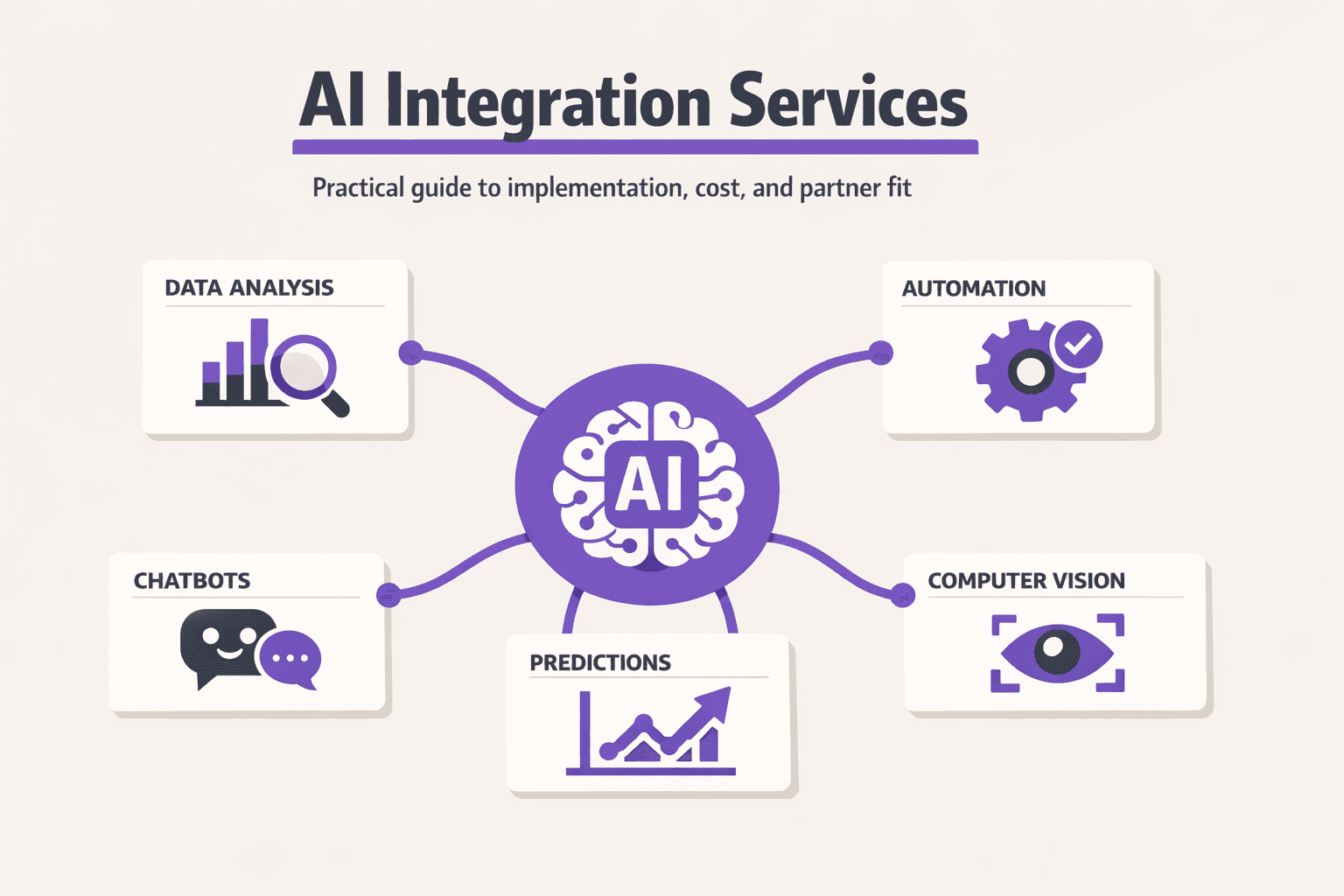
AI integration is not a single feature sprint. It is the process of embedding language models, retrieval systems, and automation workflows into existing software and data systems with production guardrails.
A mature integration engagement usually includes:
- AI readiness audit across data quality, workflow fit, and system constraints.
- Architecture design for model routing, retrieval, and tool access.
- Implementation of core capabilities such as RAG pipelines, AI agents, and structured outputs.
- Evaluation and QA with domain-specific test sets.
- Deployment, monitoring, and ongoing optimization.
The objective is not to "add AI" in isolation. The objective is to improve a business metric with controlled risk.
Build vs Buy vs Augment: the three integration models
Different products and teams need different implementation paths. Choosing the wrong model is one of the fastest ways to waste budget.
| Model | Best for | Pros | Tradeoffs |
|---|---|---|---|
| Build (custom) | Regulated domains, unique workflows, proprietary data advantage | Full control, custom UX, tailored governance | Higher initial cost and implementation effort |
| Buy (off-the-shelf) | Fast rollout of common capabilities | Fastest launch, lower upfront investment | Limited flexibility, vendor lock-in risk |
| Augment (hybrid) | Existing products adding targeted AI workflows | Balanced speed and customization | Requires stronger integration discipline |
1) Build (custom)
Custom build is appropriate when product differentiation depends on workflow design, data ownership, or strict compliance boundaries. Healthcare, fintech, legal, and complex SaaS operations often fall into this category.
2) Buy (off-the-shelf)
Off-the-shelf tooling can work for broad use cases such as generic support assistants or simple internal search. It is useful for short time-to-value goals where strict customization is not required.
3) Augment (hybrid)
The hybrid model is often the strongest practical option. Existing systems remain in place while targeted AI capabilities are layered on top through APIs, data connectors, and orchestration logic.
Decision framework: which model fits best
Use these questions to select the right model:
- Is the workflow a competitive differentiator?
- Are there strict regulatory or data residency requirements?
- Does the business need deep integration with internal systems?
- Is the outcome mostly operational efficiency or strategic product value?
A useful rule: if a workflow is high-impact and domain-specific, avoid pure off-the-shelf dependence.
The AI integration process: from audit to production
Phase 1: Audit and scope
The audit identifies feasible use cases, data constraints, and integration priorities. This phase should define success metrics before implementation starts.
Typical outputs:
- Use case shortlist by value and implementation complexity.
- Data and tooling inventory.
- Security and compliance requirements.
- Delivery plan with milestones.
Phase 2: Architecture and technical design
Architecture determines whether a system remains stable under scale and model variance.
Typical architecture decisions:
- Model strategy (single model vs routed multi-model).
- Retrieval architecture for knowledge-intensive workflows.
- Tool calling interfaces for business systems.
- Guardrails, policy enforcement, and fallback behavior.
Phase 3: Build and integration
Implementation connects model logic to real systems and workflows. This phase includes backend integration, UX adaptation, and orchestration.
Common build outputs:
- RAG pipelines connected to internal documentation.
- AI agent workflows for multi-step tasks.
- Structured output contracts for downstream systems.
- Human-in-the-loop review checkpoints.
Phase 4: Evaluation and hardening
Evaluation separates a demo from a production feature. Teams should test factuality, workflow correctness, latency, and escalation behavior.
Key evaluation categories:
- Output quality and factual correctness.
- Task completion rate.
- Error recovery and fallback reliability.
- Latency and cost per successful task.
Phase 5: Deploy, monitor, and improve
Production launch requires observability and ownership. Teams need ongoing feedback loops for prompt strategy, retrieval quality, and tool reliability.
Track at least:
- Accuracy or acceptance rate.
- Human override frequency.
- Average response latency.
- Total cost per workflow.
AI integration services pricing in 2026
Pricing varies by data complexity, system count, and reliability requirements. The ranges below are practical market baselines for serious delivery teams.
| Engagement type | Typical duration | Typical range (USD) | Notes |
|---|---|---|---|
| Discovery and AI readiness audit | 1 week | $2,000 to $5,000 | Scope, architecture direction, ROI hypotheses |
| MVP integration | 2 to 4 weeks | $10,000 to $25,000 | Focused workflow, limited systems, measurable pilot |
| Production integration | 4 to 8 weeks | $25,000 to $75,000 | Security controls, evaluation harness, monitoring |
| Ongoing optimization retainer | Monthly | $5,000 to $15,000 | Model updates, quality tuning, reliability support |
Cost alone should not drive selection. The cheaper proposal can become the most expensive if quality gates are weak and rework accumulates.
What to look for in an AI integration partner
A strong partner reduces delivery risk, not only development effort.
10 criteria for vendor evaluation
- Can map business goals to measurable AI outcomes.
- Starts with audit and scoping, not immediate implementation promises.
- Has a clear evaluation framework with acceptance thresholds.
- Designs for data governance, permissions, and auditability.
- Explains model strategy using pragmatic tradeoffs.
- Can integrate with existing APIs, data stores, and operational systems.
- Uses structured outputs and versioned contracts.
- Plans human fallback and escalation paths.
- Provides post-launch monitoring and optimization support.
- Demonstrates production examples with measurable impact.
Red flags when evaluating AI integration services
Several patterns consistently correlate with failed launches:
- No mention of evaluation or reliability testing.
- Proposal focuses on model novelty instead of business outcomes.
- No concrete strategy for data quality and retrieval.
- No fallback design for low-confidence outputs.
- No cost controls for high-volume workflows.
- No implementation plan for compliance-sensitive data.
If a proposal looks impressive but avoids operational detail, risk is high.
High-impact use cases for AI integration
High-performing teams prioritize use cases where AI can combine context, reasoning, and system action.
Examples:
- Support operations: AI-assisted triage, suggested responses, and escalation routing.
- Knowledge systems: Natural-language search across internal documentation and SOPs.
- Sales workflows: Lead enrichment, CRM summarization, and follow-up drafting.
- Operations and analytics: Natural-language querying and anomaly investigation.
- Document processing: Extraction, validation, and structured handoff to internal systems.
Integration architecture patterns that scale
Most stable implementations combine three components:
- Context layer: retrieval and data grounding for relevance and factuality.
- Action layer: tool calling and workflow execution with scoped permissions.
- Control layer: policy checks, evaluation hooks, and observability.
This architecture reduces hallucination risk and improves repeatability across workflows.
SEO and conversion strategy for AI services pages
For agencies and product teams creating inbound assets around AI integration services, content should align search intent with decision-stage questions.
Recommended structure:
- Commercial-intent landing pages for core services.
- Supporting guides that explain process, pricing, and implementation decisions.
- FAQ sections targeting high-intent "what costs, how long, what to expect" queries.
- Natural pathways between service pages and buyer guides that match reader intent.
AI Integration Services
Embed AI into existing SaaS and enterprise products with production-ready architecture, safeguards, and rollout support.
Explore serviceAI Agent Development
Design and ship tool-using agents with evaluation harnesses, guardrails, and measurable business outcomes.
Explore serviceFrequently asked questions about AI integration services
What are AI integration services?+
AI integration services are professional delivery engagements that connect language models, retrieval systems, and workflow automation into existing business products and operations with governance, evaluation, and production monitoring.
How much do AI integration services cost in 2026?+
Typical projects range from $2,000 to $5,000 for discovery, $10,000 to $25,000 for MVP delivery, and $25,000 to $75,000 for production-grade implementations, with monthly optimization retainers often between $5,000 and $15,000.
How long does AI integration take?+
An initial discovery can complete in one week. MVP integrations usually require two to four weeks. Production implementations commonly require four to eight weeks depending on system complexity and compliance requirements.
When should a business choose custom AI integration over off-the-shelf tools?+
Custom integration is usually the better option when workflows are domain-specific, tightly coupled to proprietary data, or regulated by strict compliance requirements.
What should be measured after launch?+
Track acceptance rate, task completion rate, escalation frequency, latency, and cost per successful task. These metrics reveal both quality and commercial viability.
Final takeaway
AI integration services create the most value when delivery starts with business outcomes, not model hype. Teams that combine practical architecture, strong evaluation, and governance-first implementation consistently ship faster and with lower risk.
A clear integration strategy, realistic budget framing, and disciplined partner selection can turn AI from experimental feature work into a durable operating advantage.
ai integration services
ai integration company
enterprise ai
ai consulting
ai implementation
rag pipelines
ai agents